


CARI Captures Issue 731: Southeast Asia records faster export growth to the US than China amid global trade disruptions
[feedburner name=”name”]
Captures has widened its scope to include news related to all the members of the Regional Comprehensive Economic Partnership (RCEP) agreement which was signed towards the end of 2020. Besides the ASEAN Member States, this includes Australia, New Zealand, China, Japan, and South Korea. The other weekly newsletters under CARI, China-ASEAN Monitor and Mekong Monitor will also be consolidated into the Captures newsletter. We hope this new version of Captures will serve you better and look forward to providing a curation of stories relevant to ASEAN and its trading partners.
ASEAN
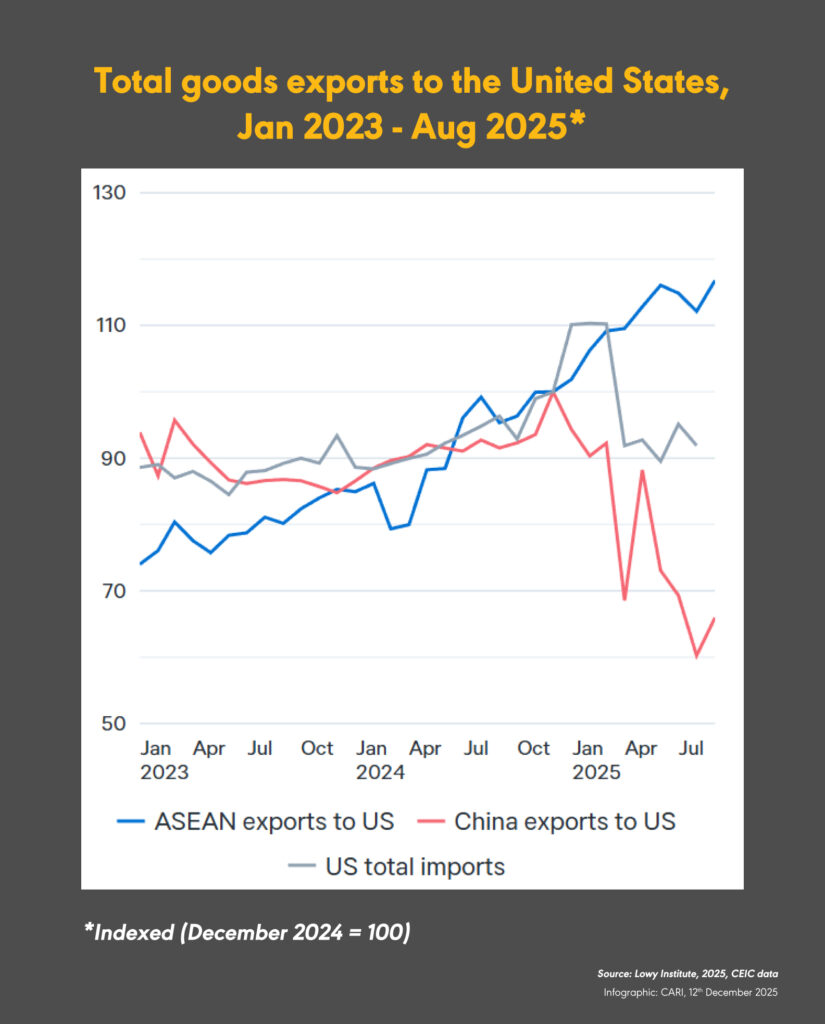
Southeast Asia records faster export growth to the US than China amid global trade disruptions
(10 December 2025) Southeast Asia has recorded faster export growth to the US than China amid global trade disruption, according to a Lowy Institute analysis. Exports from the Association of Southeast Asian Nations, comprising 11 countries, to the US increased by 23% year on year in September, with Thailand and Vietnam identified as leading contributors. The Lowy report stated that China’s share of US imports has declined over the same period. The analysis attributed part of the shift to tariff differentials, with the effective US tariff rate on China at 31% compared with about 11% for many ASEAN economies. The report noted that earlier concerns that US punitive duties and weaker Chinese demand would damage Southeast Asia’s export-led growth had not materialised as expected. Instead, exports to the US expanded as Southeast Asian goods substituted for Chinese products in the American market. Exports to other markets were also reported to be growing, despite prior expectations that they would be displaced by lower-priced Chinese goods. Lowy said Southeast Asia remains diversified in its trade structure and geopolitically aligned with the US, supporting its positioning as an alternative supply base to China. The economists concluded that the region’s openness and competitiveness have strengthened its capacity to manage ongoing trade and geo-economic uncertainty.
MALAYSIA
Gaza-linked boycott campaign accelerates growth of domestic food and beverage chains
(15 December 2025) Consumer boycotts of US-linked brands in Malaysia following the Gaza conflict have accelerated the growth of domestic food and beverage chains, according to examples cited in the article. Ahmad’s Fried Chicken expanded from a food truck to 35 outlets in just over one year and plans to reach about 110 outlets by end-2026. The business generates around MYR 3 million in monthly sales from an initial MYR 700,000 investment for its first physical outlet opened in December 2024. Malaysian coffee chain Zus Coffee doubled its store count in 2024 as Starbucks’ footprint contracted and now operates more than 700 outlets nationwide. Zus Coffee has expanded outside Malaysia since late 2023, opening stores in the Philippines, Thailand, Singapore, and Brunei Darussalam, and localising products such as ube-flavoured drinks in the Philippines. Viewfinder Global Affairs described the consumer shift towards local brands as permanent. Malaysia’s food-service industry is projected by Mordor Intelligence to grow to USD 27.5 billion by 2030, compared with more than USD 1.5 trillion in the US. Analysts cautioned that some local brands may face resource constraints as expansion continues. Berjaya Food has stated that Starbucks Malaysia remains confident in the brand despite store closures and losses, noting that business is gradually recovering. The article indicates that once consumers switch to local alternatives, many report no intention of returning to international brands.
MALAYSIA
Malaysian ringgit on track to outperform other Asian currencies for second consecutive year
(15 December 2025) The Malaysian ringgit is on track to outperform other Asian currencies for a second consecutive year, with several strategists projecting further gains into 2026. Strategists from Bank of Singapore and MUFG Bank expect the ringgit to trade near 4.00 per US dollar by end-2026, while Goldman Sachs forecasts appreciation to 3.95, the strongest level in seven years. The currency has strengthened by more than 9% against the dollar this year and was last quoted at 4.0982 on Monday after two sessions of gains. Analysts cited Malaysia’s role in the global technology supply chain, rising artificial intelligence-related demand and increased foreign direct investment, particularly into data centres, as key drivers. Bank Negara Malaysia is expected to maintain a stable policy stance, with Goldman Sachs noting limited scope for further easing, which may narrow yield differentials even as the US Federal Reserve signals one more rate cut in 2026. Central bank data showed data-centre export services rose to MYR 10.7 billion in the first nine months of the year from MYR 1.2 billion in the same period of 2024. Goldman Sachs strategists said valuation models indicate the ringgit remains significantly undervalued. Technical indicators show the dollar-ringgit pair has breached support at 4.0947, the September 2024 low, suggesting a move towards 4.00. Malaysia’s trade data scheduled for release on 19 December is identified as a potential near-term catalyst if it confirms continued strength in technology exports.
INDONESIA, UNITED STATES
Indonesia expects trade agreement with the US to be concluded by year-end
(12 December 2025) Indonesia expects to conclude a trade agreement with the US by the year’s end, and will send a delegation to Washington next week to finalise outstanding issues. Indonesia’s Coordinating Minister for Economic Affairs said discussions aim to complete commitments agreed by the leaders on 22 July, following his call with the US Trade Representative. The July trade framework provides for Indonesia to eliminate tariffs on more than 99% of US goods and remove non-tariff barriers. In return, the US would cut tariffs on Indonesian exports from a proposed 32% to 19%. US officials have accused Indonesia of backtracking on elements of the agreement, while Jakarta has resisted US demands it views as undermining policy independence, particularly in critical minerals and energy. Indonesia has objected to provisions allowing the US to revoke the deal if Jakarta signs agreements considered harmful to US interests. The minister said those provisions would not apply to Indonesia and that the issue would be resolved in the upcoming talks. PT Bank Maybank Indonesia said the completion of the agreement would provide positive sentiment for foreign investors.
INDONESIA
Employer’s association claims proposed provincial minimum wage rise is too high
(17 December 2025) Indonesia’s provincial minimum wages are set to rise by between 5.3% and 7.3% next year under a new government regulation, according to an official from the employers’ association APINDO. The manpower ministry on Tuesday introduced a revised wage-setting formula incorporating inflation, economic growth and labour’s contribution to growth. APINDO said the proposed increases were too high and that many companies were unable to meet this year’s minimum wage levels. Under the new rule, provincial governors have until 24 December to determine the 2026 minimum wage increases for their respective regions. The Labour Party, representing unions, had sought a minimum increase of 6.5% in line with this year’s economic growth. The Labour Party said the party would issue its formal response to the new pay regulation later on Wednesday.
SINGAPORE
Singapore’s non-oil domestic exports increase by 11.6% year-on-year in November
(17 December 2025) Singapore’s non-oil domestic exports increased by 11.6% year on year in November, exceeding the Reuters poll forecast of 7.0%, according to government data released on Wednesday. The expansion followed a revised 21.7% rise in October. Growth was led by pharmaceuticals and supported by electronics, including integrated circuits and personal computers. Enterprise Singapore reported strong export gains to the US, the European Union and Taiwan. Shipments to Thailand and Japan declined compared with a year earlier. In November, Enterprise Singapore narrowed its 2025 non-oil domestic exports growth forecast to around 2.5% from a previous range of 1% to 3%. The agency cited expected support from artificial intelligence-related demand and elevated gold prices in the fourth quarter. The Trade Ministry expects Singapore’s GDP growth to be around 4.0% this year.
VIET NAM
Viet Nam projected to receive record 21 million foreign tourists in 2025
(16 December 2025) Viet Nam is projected to receive a record 21 million foreign tourists this year, surpassing the pre-pandemic peak of 18 million recorded in 2019, according to the Ministry of Culture, Sports and Tourism. The ministry said foreign arrivals are up 19.3% year on year, and the country marked the arrival of its 20 millionth international visitor on Monday at a ceremony on Phu Quoc Island. The rebound follows a low of fewer than 160,000 foreign arrivals in 2021 during COVID-19 travel restrictions. Data from the National Statistics Office showed China was the largest source market in the first 11 months, accounting for about 25 percent of total arrivals. Other key source markets included South Korea, Taiwan, the United States and Japan. The ministry acknowledged ongoing challenges from severe air pollution, with Hanoi ranking among the world’s most polluted cities at times this year, and flooding affecting destinations such as Hue, Hoi An and Nha Trang.
RCEP Monitor
SOUTH KOREA, UNITED KINGDOM
South Korea and the UK finalize trade agreement extending tariff-free arrangements
(16 December 2025) The UK and South Korea have finalised a trade agreement extending existing tariff-free arrangements and preventing the expiry of provisions due in January 2026. The deal maintains tariff-free treatment on 98% of bilateral trade, matching the terms South Korea has with the EU, and is intended to protect GBP 2 billion of UK exports from higher tariffs. UK government statements said the agreement would support exports including Bentley vehicles, Scottish salmon and Guinness canned in Britain. South Korea is the UK’s 25th largest trading partner, accounting for 0.8% of total UK trade in the 12 months to end-June. Over the same period, UK exports to South Korea fell 16.4% and South Korean exports to the UK declined 10.8%, according to official figures. South Korea’s trade minister said the agreement focuses on reducing non-tariff barriers, including more business-friendly rules of origin, and adding digital and investment protections. The UK government described the deal as its fourth trade agreement since Labour took office, following deals with the EU, the US and India. The Office for Budget Responsibility has previously assessed that post-Brexit trade deals are unlikely to have a measurable impact on UK economic growth by 2030. The government has said the agreements will support jobs and reduce red tape for small businesses, although its own assessment showed the India deal would raise GDP by 0.11% to 0.14%. UK companies including Bentley Motors and Diageo welcomed the South Korea agreement, citing improved market access and demand growth.
JAPAN
Exports rise 6.1% year-on-year in November 2025, fastest pace in nine months
(16 December 2025) Japan’s exports rose 6.1% year on year in November, the fastest pace in nine months, according to finance ministry data released on Wednesday. The increase exceeded the Reuters poll forecast of 4.8% and accelerated from 3.6% in October. Shipments to Western Europe surged 23.6%, while exports to the US increased 8.8%, marking the first rise since March. Automobile exports declined 4.1% by value, although auto shipments to the US recovered with a 1.5% year-on-year increase. Exports to mainland China fell 2.4%, with foodstuff exports to China down 5.9%, while shipments to Hong Kong rose 11.4%. The data followed revised third-quarter GDP figures showing a deeper contraction of 0.6% quarter on quarter, or 2.3% on an annualised basis. Imports increased 1.3% in November, below expectations of a 2.5% rise. Tensions with China escalated in November after Prime Minister Sanae Takaichi said a Chinese attempt to seize Taiwan by force could prompt Japanese military intervention, after which Beijing restricted imports of Japanese seafood. The Bank of Japan’s Tankan survey showed business sentiment improved in the fourth quarter, particularly among small manufacturers. Monex Group highlighted strength in semiconductor and equipment exports linked to US-led technology investment. Exports of electrical machinery rose 7.4% and semiconductor-related exports increased 13% year on year, supporting Japan’s position in specialised manufacturing equipment.
NEW ZEALAND
Reserve Bank of New Zealand to ease some capital requirements for banks
(17 December 2025) New Zealand’s central bank has decided to ease some capital requirements for banks following a review of rules introduced in 2019, while keeping standards above international norms. The Reserve Bank of New Zealand said the four largest Australian-owned banks must hold common equity tier 1 capital of 12%, down from 16%, while tier 2 capital requirements will rise to 3% from 2% and internal loss-absorbing capacity will be set at 6%. Total capital requirements for smaller banks will be reduced to 14% from 16%, with the central bank describing the revised settings as relatively conservative by global standards. The central bank’s governor said the changes are expected to lower funding costs and support increased lending and lower interest rates. The central bank estimated average funding costs would fall by 12 basis points, generating an annual net benefit equivalent to 0.12% of GDP compared with full implementation of the previous rules. The original capital framework, announced in 2019, was due to be fully implemented by 2028 but was reviewed after criticism that it was pushing up borrowing costs and weighing on economic growth. The banking sector is dominated by Westpac, ASB Bank, Bank of New Zealand and ANZ, all Australian-owned. The New Zealand Banking Association said the impact would vary across banks depending on size and existing capital positions. The Cooperative Bank said the changes would help address challenges faced by smaller lenders and support competition. The Reserve Bank will publish further details in February and consult on specific requirements, with full implementation still expected by 2028.
|
15 participating countries |
20 chapters |
2.2 billion |
US$26.2 trillion |
28% |
| ASEAN member states, Australia, China, Japan, South Korea, New Zealand | trade in goods and services, investment, intellectual property, e-commerce, competition, SMEs, economic and technical cooperation, and government procurement | combined population, 30% world’s population | combined GDP, 30% global GDP | global trade (based on 2019 figures) |