Press Release: Appointment of Tan Sri Dr. Munir Majid as Chairman of CARI

Kuala Lumpur: Tan Sri Dr Munir Majid has been appointed Chairman of CIMB ASEAN Research Institute (CARI) with effect from 1 February 2014. The appointment is for two years. Munir takes over from Bapak Glenn Muhammad Surya Yusuf who will remain on the board of CARI.

CARI was established in 2011 by CIMB Group as a not-for-profit research unit in support of ASEAN economic integration, and the Asean Economic Community (AEC) in particular. CARI conducts practical oriented research and helps focus the private sector’s interest into meaningful progress towards an integrated and competitive ASEAN economy. CARI is also the secretariat of the ASEAN Business Club (ABC), a network of leading ASEAN multinational CEO’s. It is the first independent, transnational research institute dedicated solely to the advancement and acceleration of the ASEAN integration agenda.

“We are pleased to welcome Tan Sri Munir back to CIMB Group in this new capacity. With his experience, intellect and network, he will reinvigorate CARI and ABC at a crucial time, with AEC fast approaching,” said Dato’ Sri Nazir Razak, Group Chief Executive, CIMB Group.

Munir said, “The next two years are challenging as ASEAN seeks to become a community based on three pillars – economic, political and socio-cultural. However, although business people are most interested in the AEC, even among them there is insufficient consciousness of the challenges – and opportunities. Governments in the region glibly declare progress towards the creation of the ASEAN community by the end of 2015 but there is a significant gulf between rhetoric and reality.”

“CARI hopes to help narrow the gulf, fill in the gaps and highlight the opportunities – a huge challenge. It will do its best, not only through research products but also by supporting regional integration effort by bodies such as the ABC and the ASEAN secretariat.”

“After a lifetime working in journalism, in the private and the public sector, and doing academic work on Southeast Asia, I am most excited to bring both knowledge and practical experience to the task and look forward to the support of kindred spirits,” Munir added.

Munir is the Chairman of Bank Muamalat Malaysia Bhd, and has been on its board since 2008. He obtained his B.Sc (Econ) from the London School of Economics and Political Science in 1971, and his PhD in International Relations in 1978. He was teaching at the Department of International Relations of his alma mater from 1972-1975, and was an analyst for Daiwa Europe NV in London from 1975-1978.

When he returned to Malaysia at the end of 1978, Munir joined The New Straits Times Press (NSTP) as a lead writer and progressed to become its Group Editor. He left The NST in 1986 to become the CEO of a small merchant bank, Pertanian Baring Sanwa (PBS), which then became Commerce International Merchant Bankers, the genesis of today’s CIMB Group.

Munir left CIMB in 1993 at the invitation of the Government of Malaysia to set up the Securities Commission and became its first Executive Chairman for two terms until 1999. Munir continued on with his illustrious career, serving in various capacities, including as Chairman of both Celcom and Malaysia Airlines System at different times. He is the founder and President of the Kuala Lumpur Business Club (2003-2008) and is now the chairman of its Advisory Council. In December 2005, he was made an Honorary Fellow of the London School of Economics and Political Science, and in 2008, a Visiting Senior Fellow of LSE IDEAS (Centre for the Study of International Affairs, Diplomacy and Strategy) where he heads the Southeast Asia International Affairs Programme. He is also a member of the International Institute of Strategic Studies in London.

Launch of Lifting-The-Barriers Reports 2013

LTB Launch

The ASEAN Business Club (ABC) launched the Lifting-The-Barriers (LTB) Reports on the 29th November 2013. This concludes the final phase of the LTB Initiative for the calendar year 2013. The six reports outlined the bottlenecks and barriers hindering free trade in the region as well as highlighting possible solutions to accelerate integration efforts to meet the deadline of the ASEAN Economic Community (AEC) 2015.

The Launch was attended by the ASEAN Secretary General H.E. Le Luong Minh, Dato’ Sri Nazir Razak (Group CEO, CIMB Group), Tan Sri Dr. Munir Majid, Bapak Patrick Walujo, distinguished public sector participants and many members of the international media.

The Guest of Honour, H.E. Le Luong Minh delivered a keynote address acknowledging the critical importance of increased private sector engagement through various platforms such as this LTB Initiative.

The press conference which followed saw some in-depth and comprehensive issues raised by the media.

In summary, the Launch marked a successful closing of the LTB Initative for the year 2013.


img-naf13-image20.jpg

img-naf13-image20.jpg

img-naf13-image20.jpg

3rd Meeting of China-ASEAN Inter-Bank Association (CAIBA) Executive Board

885A3309


885A3353
 

From the 16th to the 18th of October, the third meeting of CAIBA was held in Beijing focusing on three different seminars. The focus was on China-ASEAN Connectivity Infrastructure, a workshop for Financial Supervision and Bank Risk Prevention and Control. Ms. Hong Jukhee presented on “ASEAN Connectivity” and received encouraging response from fellow participants.

Standard Chartered Regional Executive Forum

rofx-img

CARI and the ABC were invited by the Chief Executive of Southeast Asia, Neeraj Swaroop to talk about the efforts of ABC bringing ASEAN corporates together in support of ASEAN integration. The South East Asia Regional Executive Forum (REXFO) of Standard Chartered is a close door high-level event made up of functional and business heads from the region. It was held on the 7th of November 2013 in Kuala Lumpur. Ms. Hong Jukhee presented on “ASEAN Integration: For the Private Sector” touching on the implications of the AEC on business and how they can prepare.

ASEAN Master Class for CIMB Commercial Banking

P1010140


CARI in partnership with CIMB Commercial Banking led a business delegation to Myanmar, bringing together 60 of CIMB’s clients’ senior management from 48 different countries. This meeting brought together experts, market leaders, and policy makers to share ideas concerning the ASEAN Economic Community (AEC).


image5


image4


International Institutional Investor Series 2013

Jointly organized by the Malaysian Association of Asset Managers (MAAM) and the Securities Industry Development Corporation (SIDC), the IIS 2013 was themed The World is Becoming Smaller: How Malaysia is Affected by External Events and How to Adjust to Them. Ms. Hong Jukhee moderated an ASEAN session with a panelists, Datuk Dr. Rebecca Fatima Sta Maria, Secretary General of Ministry of International Trade and Industry, Eugene Wong, Executive Director of Corporate Finance & Investments Business Group at the Securities Commission and Aznan Abdul Aziz, Director of Financial Sector Development at Bank Negara Malaysia.

maam-img02


Now you see it, now you don’t

08 March, 2014
As appeared in TheStar.com.my

InternationalReservepdf

ALTHOUGH not rip-roaring, the Malaysian economy is on an even keel.

Growth numbers have been consistent over a period of years now. Last year GDP growth was 4.7%. Although less than the 5.6% of the previous year, it was held up in the final two quarters, in line with the uptick in the global economy which has been showing encouraging signs. Even the normally under-stated International Monetary Fund (IMF) suggested: “Is the tide rising?”

For the first time since the dark days following the 2008 financial crisis, there are chinks of light and grounds for optimism. After about 3% last year, the global economy is forecast to grow by 3.7% in 2014, 3.9% in 2015. The US economy, Britain and even the EU are looking positive.

Although the Chinese economy seems to be flattening at around 7%, there is thus more than compensating external demand from the advanced countries for the Malaysian economy. It is expected that exports will be the main driver of growth this year, as domestic demand was last.

This is of course not mutually exclusive. There are massive projects under the Economic Transformation Programme (ETP) and the 10th Malaysia Plan that will continue to drive the economy: for example MRT 1, 2 and 3 which are valued at RM90bil if we included the LRT; projects such as the KL-Singapore high speed railway (RM30bil), East Coast Region railway (RM30bil), Tun Razak Exchange (RM20bil), Sungai Buluh RRI (RM10bil) and a few more.

Where government funding is involved, clearly the debt incurred has to be watched. At the moment, government debt is 53% of GDP although with quasi-government debt the figure is 60%, above the prudent ceiling of 55%. To repeat, prudent economic management means this has to be watched. We do not want to go the Greek way.

But look at the tables to see solid numbers which show the economy’s resilience and continued attractiveness. It has not been plain sailing. Sometimes it has been a struggle, after the 1997-98 financial crisis, after the Great Recession that followed the 2008 crisis. Tough world, but Malaysia stands firm.

FDI flows are increasing in all sectors, but particularly manufacturing and services as well as the mining sub-sectors. The surplus on the current account of the balance of payments has see-sawed. However it is widening again.

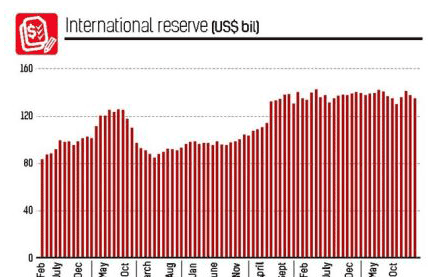
The reserve position is particularly strong – despite emerging market capital outflows. International reserves are sufficient to finance well over nine months of retained imports and are 3.4 times the short-term external debt.

And, Malaysia’s share of the vibrant global sukuk market has been about 70% since 2012 when the nominal value of amount placed was almost US$140bil.

Numbers, numbers, numbers, positive or not, what do I care if prices are rising.

Well, the short answer is you might very well be out of a job if those numbers become negative or show a downward trend. Investment will not take place. The ringgit will come under attack. Asset values will fall. Banks will get into trouble. Loans will have to be recalled.

It is therefore critical that the Government shows fiscal discipline, a true commitment to address the deficit that does not waver under pressure. Whatever else may be said about Prime Minister Datuk Seri Najib Tun Razak, he is actually the first to address the deficit for a very long time – and it already shows a positive outcome: 3.9% of GDP against targeted 4%.

It may seem a small number, but it is a giant leap for Malaysia. For the longest time, under at least two previous administrations before Najib, the Government has been talking about reducing subsidies which were a prime cause of the deficit – but did nothing about it to remain popular.

For the longest time previous administrations blew hot and cold about the GST while muttering the mantra on the need to widen the tax base beyond dependence on Petronas, on 1.7 million tax payers alone and on whatever corporate taxes collected whose rate is always under pressure in a competitive global economy.

Only now has something been done. The Government’s fiscal consolidation is viewed positively across the world. Malaysia’s A3 sovereign rating stands a chance of upgrade, which will be positive for bond markets (lower borrowing rates) and ensure a strong ringgit, even as other emerging market currencies are being bashed about.

Why does it matter? Because it means confidence, investment, growth, jobs.

What the Government has failed to do is to communicate effectively – there is a trade-off between some level of price increase and the long-term health of the economy to be gained, apart from the other fundamentals, from fiscal discipline and consolidation – a communication in simple language and one which is believed.

We can say we don’t want to become another Greece. We can say… look what happened to Indonesia in 1998. We can show what is hitting other emerging markets and why.

The big problem is there does not seem to be a clear communication plan (which must include one on the GST – Australia educated consumers for one year before the tax was introduced). And then there is the problem of credibility of the conventional media.

Whatever the good numbers, the people don’t want to believe them. They would rather believe everything they read in the social media. A credible conventional media is in the national interest. We cannot continue to have a media that is not believed. It hurts our country because people refuse to see the good as they believe none of the bad is ever aired. No balance, which is the reality of life, of the economy.

If I told a housewife coming out of the market with her heavy basket the inflation rate was 3.4%, she would pull out the largest cucumber (which has gone up in price by much more than that) and hit me on the head. So people have to be better informed about numbers, what they mean, what is general, what is specific. What they imply in terms of consumption patterns.

Most of all, why prices are increasing, what will happen if we sit on our hands and did nothing about the government deficit, and when all this bit of bother will result in bigger economic gains.

ASEAN: Focus on regional interest

22 February, 2014
As appeared in TheStar.com.my

RESEARCH commissioned by CIMB Asean Research Institute on behalf of the Asean Business Club shows gaps in achieving the Asean Economic Community (AEC) regional promise.

These can be filled by a concentration on the regional interest which takes care of the national interest as well.

Take aviation. The Asean Open Skies policy which is supposed to come into effect in 2015 is frustrated by member states, most significantly Indonesia, opting out of the granting of fifth freedom rights to other Asean carriers. With fifth freedom carriers can discharge and pick up passengers enroute to third Asean countries instead of being limited point to point between countries.

Clearly, with fifth freedom the much vaunted Asean connectivity would be enhanced. Yet it is blocked ostensibly to protect the national airline industry and domestic markets.

However, businesses must, and can, fend for themselves. If they do not, they will be gobbled up in a globalised world economy. Thus Indonesia’s very own Lion Airline, not only competes in its own market but also ventures into other markets. Its joint venture in Malaysia, Malindo, is making inroads – or rather airwaves – in the region and beyond.

What’s sauce for the goose is sauce for the gander. Indonesia has many big and successful companies that can come out and take on the competition.

Otherwise, if domestic companies are supine and protected, their markets will be attacked, as experienced by the protected motor car industry in Malaysia. It is not just the open world economy. New arrangements are coming on-stream such as the Regional Comprehensive Economic Partnership and the Tran-Pacific Partnership which will cut deep into Asean markets.

Still with aviation, Asean actually signed an Air Transport Agreement with China in 2010 whose provisions accord fifth freedom rights to Chinese carriers within the region. It is most strange that there is parsimony with its own regional carriers but not with those from China.

I am not arguing that Chinese carriers should be denied but that Asean carriers SHOULD NOT be denied. Indeed it would make good sense for Asean carriers to get stronger against the competition by forging an Asean airline for instance. The narrow national interest is becoming increasingly untenable.

Not only to fend off challenges but also for forging combined benefit.

McKinsey finds Asean infrastructure investment lagging behind the global average of 3.6% of GDP. While Vietnam and Malaysia are closest to investing to meet infrastructure stock of around 70% of GDP, to achieve advanced-economy level of productivity, most others are way behind.

It is estimated Asean needs infrastructure investment of a staggering US$2.4 trillion between 2013-2030 to reach this 70% level.

A little drop in the ocean that would push this along would be an initiative to allow infrastructure project listing across Asean markets based on a common trading platform. This will encourage regional investment as well as investment from outside the region, attracted by the greater size and liquidity of the Asean infrastructure equity market.

With the takeout source offered by a listing, the infrastructure project(s) will be more attractive for initial debt financing. Infrastructure project listing, obviously without track record, but with projected future cashflows verified by internationally-recognised specialists, was successfully introduced when I was chairman of the Malaysian Securities Commission. A regional incarnation would be of assistance to the Asean infrastructure development agenda.

The benefit of good infrastructure is immense, both in generating further investment and growth, and in providing the people with the means of a good life. In the context of the AEC, it would help narrow the economic disparity between member states, which is one of the four bases on which it is predicated.

If Asean capital markets were better integrated, to begin with for infrastructure projects alone, their greater size and liquidity would attract more substantial investment funds. While there is resistance to that better integration, largely based on the narrow interests of domestic intermediaries, the benefit to the larger regional and national interest of an Asean infrastructure equity market would have positive demonstration effect.

As it is, the size of individual Asean markets exposes them to the crush of reverse investment flows which damage their currencies and real economies. Bigger, more liquid markets, with Asean champion companies listed on them can better withstand the capriciousness of financial markets. If only Asean leaders, in government and the private sector, will see this. Of course, every Asean country must work to strengthen its fundamentals – of which better infrastructure would certainly be a huge piece of the jigsaw.

There is better economic news from some advanced economies like the US, Germany and Britain, pouring in like beautiful winter sunshine. Emerging economies like those in the Asean region – despite the best efforts of recalcitrant financial markets – should gear themselves up to take advantage of a positive sentiment lost in the dark days since the 2008 financial crisis.

Asean, to boot, has its AEC calling to answer: 600 million people market, an economy of well over US$2 trillion which, if it was one, would be the eighth largest in the world with a growth rate near double the global average after registering 9% in the two decades up to 2011, right at the crossroads between India and China. Even for the smallest part of the whole, this must be something worth realising.

Brutal financial markets

8 February, 2014
As appeared in TheStar.com.my

Malaysia had better beware…

WHILE markets may be uncertain about the real economy, they can be brutal about destroying value.

A Guardian columnist described a conclusion of cautious optimism at Davos last month this way: Cautiously optimistic and time will tell are just polite ways of saying “I haven’t got a clue.”

He was describing the state of uncertainty about the condition of the world economy. Short-term prospects for growth are good, especially for recovering advanced economies like the US and Britain. Yet it is not clear whether the recovery will be sustained. What is certain now is emerging economies are wobbly.

But why? Markets have found they are not so pretty after all. Only tarted up by US quantitative easing (QE). Excess money not then attracted to the home market it was supposed to be invested in found a home with dodgy people who apparently looked attractive in the dark.

Suddenly in the light of day introduced by the tapering of US QE you see, not what was wrong with you, but with those dolly-birds now with their make-up removed. A further reduction in QE from February to US$65bil has given the shivers reminiscent of the rush for the door that took place last May when Ben Bernanke first intimated the US Fed would scale back purchases of bonds from the then US$85bil a month.

You run. There is a run. The Argentine peso has been hit hard. The South African rand reached a five-year low. The Turkish lira, Russian ruble and the Indian rupee are all now very much weaker. Subsequent interest rate increases by Turkey, South Africa and India failed to stem the falls.

Will there be contagion? Shades of 1997? Who’s next?

There’s no recompense from Japanese QE, or the European Central Bank (ECB) easing policy to counter the threat of deflation. Or from the Bank of England, fumbling with “forward guidance” on when it will start looking at interest rate rises, which does not help even if the British economy shows promising signs of recovery, registering growth of close to 2% last year.

Really nothing can replace the size and certainty of American QE, unless it is the certainty of American economic growth. That potential growth now looks promising, although markets are uncertain.

How are emerging economies suddenly weak? This, markets now seem certain about. It all began when the US economy started to look good. And, of course, there is less money to play around with in those economies. What with glimmers of hope in the UK and Europe and Japan, emerging economies are really not that hot after all.

Don’t forget, China’s slowing down. When the figure came in of 7.7% growth last year against much lower expectation, it is of course suspect. Recent manufacturing numbers, anyway, do not look good. And remember, China has serious structural problems to address as well. The narrative must not be disturbed.

Thus, while there is no contagion (as yet?), there are causes of market distress specific to different emerging economies. Argentina: large current account deficit; meagre foreign currency reserves; domestic inflation about 25% (How I would want to get into that market in the first place, I don’t now know; all I know is I want to get out quick!)

Brazil and South Africa: signs of slowing (sic) Chinese economy and financial distress among shadow financial institutions (and China also has them, lurking to get into deep trouble any time now).

Russia: price of commodities driven by Chinese growth coming down (But not Australia?). Turkey and India: US QE tapering may deplete flows of liquidity necessary to finance current account deficits and short-term debt.

Quartz Daily Brief does an even better service by classifying emerging economies into several interesting categories: Serial political mismanagement (Venezuela, Argentina, Ukraine); Living beyond their means (Turkey, South Africa, Peru, Chile, Indonesia, Thailand) – which are also the most vulnerable to the US Fed QE taper; Fragile banking sectors (Hungary, Romania, Croatia); Domestic structural problems (Brazil, India, China, Russia which need to open up sectors run by the state, invest in infrastructure, stimulate domestic demand, fight inflation and corruption or improve financial systems).

Morgan Stanley now coins an alliterative grouping – the Fragile Five: Brazil, India, Indonesia, Turkey and South Africa. And so it goes on.

Malaysia, thankfully, has not been cast into any of the categories, although the ringgit has weakened against the dollar and the stock market is not looking too steady along with the rest of emerging markets.

However, the country seems to be straining at the leash to get into one of those holes. We must understand once the markets smell the blood of political trouble or fiscal laxity and indiscipline, we will be thrown to the wolves of Wall Street.

Never mind that markets themselves are no paragons of discipline. They have the power to sniff indiscipline and disorder, and to impose a cost on the country, which can be debilitating especially for a relatively small market and economy like Malaysia.

No point the country moaning about it. It is in the game. The central bank is doing an excellent job, but not the politicians who seem to have a death wish. The disorder that threatens the country over an emotional controversy on the use of the word “Allah” can cost the country dear.

Political trouble in Thailand has become par for the course, but if politically pristine Malaysia becomes unstable, financial markets will punish the country. Thailand knows how to deal with instability, Malaysia is not so well poised. Ironic, but we should not tempt the markets.

And then if there is a weakening of resolve as well to address the budget’s current account deficit in the face of opposition against the removal of subsidies, there will be hell to pay in terms of the future of the country’s economy, currency, financial and capital markets.

While Malaysia has to manage price increases, it cannot avoid them if it wants to address the fiscal deficit. Unfortunately, too many decisions on revenue and expenditure were put off for the longest time. Something has to be done now, even if the present government has to bear the brunt. It has to carry out its responsibility if the country’s economy is to avoid severe damage.

In 1997-98, the Indonesian GDP came down by 13% to 14%. More recently in the euro crisis, Greece lost 23%. Most of all, this means unemployment shooting up with miserable social and economic outcomes.

This existential threat must be understood and communicated in a clear and simple manner so that the people can appreciate the risks the country faces if it does not hold together to address political and fiscal issues.

Indeed word is out in financial markets Asean faces in 2014 an outlook clouded by political risks. Already GDP growth has been marked down from 5% last year to no more than 4.7% in 2014. With political trouble in Thailand, elections coming up in Indonesia, Malaysia as the region’s third largest economy should not want to add to these political risks.

The bottom line is whatever the economic prospects of the real economy, if market forces sense trouble of any kind that is not liked, those prospects will never be realised. The real economy will be pulled down by the destruction of value of financial assets that will put it at the starting line again.