


CARI Captures Issue 765: Export arm of Indonesia’s sovereign wealth fund Danantara launches export monitoring platform
Captures has widened its scope to include news related to all the members of the Regional Comprehensive Economic Partnership (RCEP) agreement which was signed towards the end of 2020. Besides the ASEAN Member States, this includes Australia, New Zealand, China, Japan, and South Korea. The other weekly newsletters under CARI, China-ASEAN Monitor and Mekong Monitor will also be consolidated into the Captures newsletter. We hope this new version of Captures will serve you better and look forward to providing a curation of stories relevant to ASEAN and its trading partners.
INDONESIA
Export arm of Indonesia’s sovereign wealth fund Danantara launches export monitoring platform
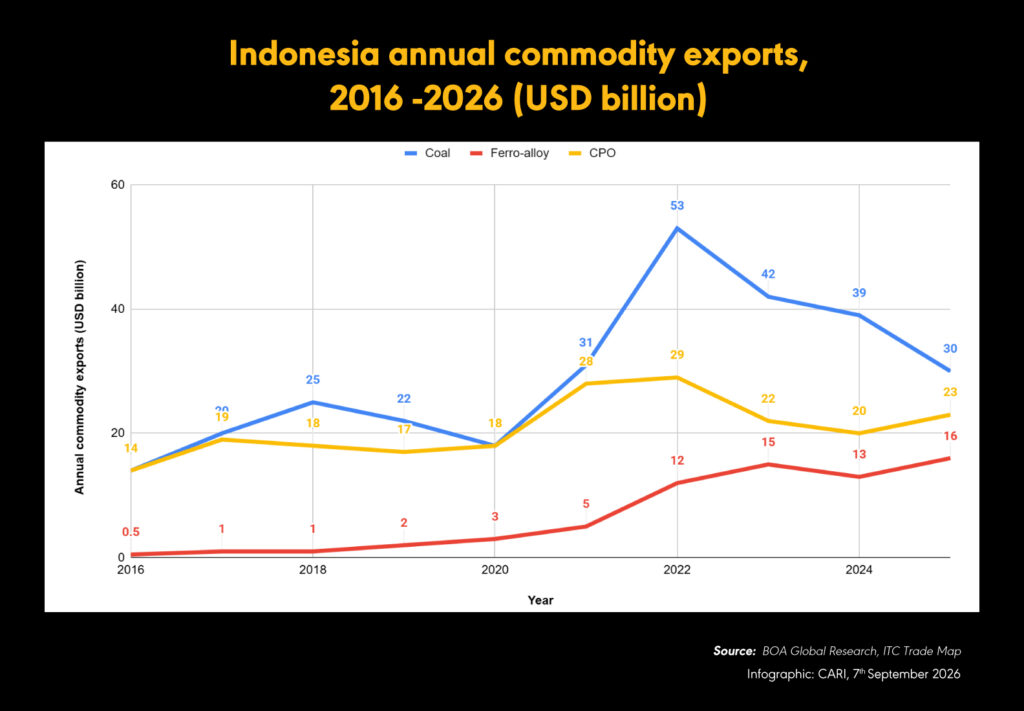
(31 August 2026) Danantara Sumberdaya Indonesia (DSI), the export arm of Indonesia’s sovereign wealth manager Danantara, is launching an export monitoring platform on 01 September covering coal, palm oil and ferro-alloys with combined annual trade flows exceeding USD 70 billion. The platform will verify export quantity, quality, classification, pricing, destinations, payment terms and repatriation of export proceeds, using integrated data from government agencies to identify potential under-invoicing and transfer pricing. DSI will act as an intermediary rather than the sole exporter, scaling back the government’s original proposal, with full implementation targeted by the end of 2026. Since beginning operations in June, DSI has monitored more than 6,500 export declarations covering about USD 14 billion in shipments. The framework could eventually expand to other commodities, although DSI said this would be gradual. Exporters and industry groups have sought greater clarity on reporting obligations, treatment of existing contracts, transition arrangements, pricing benchmarks and potential fees. Concerns are particularly significant for ferro-alloy producers because products such as ferro-nickel are traded through bilateral contracts with varying grades and specifications. President Prabowo Subianto’s plan to establish an Indonesian mineral and commodity exchange could eventually link DSI’s monitoring infrastructure to broader efforts to increase Indonesia’s influence over commodity pricing.
VIET NAM
Foreign franchises struggle to compete in Viet Nam’s beverage market
(01 September 2026) Viet Nam’s modern coffee and tea chain market reached an estimated USD 1.34 billion in 2025, with coffee chains growing 27% year-on-year to USD 725 million and tea chains rising 28% to USD 617 million, but foreign franchises continue to struggle to achieve large-scale expansion. Starbucks had 125 stores by end-2024 and surpassed 150 in January 2026, compared with 985 Highlands Coffee outlets by end-2025 and roughly 2,500 Milano Coffee locations. Chagee’s expansion was constrained after a March 2025 boycott over imagery containing China’s “nine-dash line” on its digital channels, while Café Amazon closed its remaining Vietnamese outlets in November 2025 after five years. Mixue has consolidated its Vietnamese store network following rapid franchising and intra-brand cannibalisation, while Gong Cha, KOI Thé, The Alley and Tiger Sugar remain at approximately 50 to 70 outlets each. Domestic operators increasingly compete across mass-market and premium segments, while Vietnamese consumers show willingness to pay premium prices for product quality, atmosphere and social experience rather than foreign brand origin alone. The article identifies market saturation, rapid local imitation, entrenched domestic supply chains and real-estate networks, and geopolitical reputational risks as major constraints on international expansion. It concludes that strong product-market fit alone is insufficient for foreign chains to achieve category-defining scale in Vietnam’s highly localised and competitive beverage market.
VIET NAM, THE PHILIPPINES
Viet Nam and the Philippines intensify engagement to address issues in bilateral rice trade
(30 August 2026) Viet Nam intensified engagement with Philippine authorities from 19-21 August to address issues in their bilateral rice trade, particularly the Philippines’ safeguard investigation into imported rice. A Vietnamese inter-sectoral delegation led by the Deputy Minister of Industry and Trade met the Philippines’ DTI, DFA, Tariff Commission and Department of Agriculture. Both sides agreed to continue implementing the existing MoU on rice trade cooperation, maintain information exchanges and minimise adverse effects on bilateral trade. Viet Nam proposed upgrading the MoU or establishing a more legally binding and stable framework for long-term rice cooperation, which the Philippine side agreed to study. The Tariff Commission said the safeguard investigation would be conducted fairly and transparently under WTO and ATIGA rules and requested continued Vietnamese participation in a public hearing scheduled for September 2026. Viet Nam urged the commission to consider Philippine import policies, including lower tariffs and SPS import clearances, and the role of imported rice in supply, price stability, and food security. The Philippine side reiterated that Viet Nam remains a stable major rice supplier despite efforts to diversify import sources. The Vietnam Food Association and Philippine Rice Industry Association also agreed to strengthen information sharing, business links and coordination on commercial difficulties.
THE PHILIPPINES
Philippine peso falls to record low against US dollar amidst pressure of high oil prices
(31 August 2026) The Philippine peso fell 37.7 centavos to a record closing low of 62.265 per US dollar on Friday, extending three straight weeks of losses for the peso and surpassing the previous record of 61.888 set the previous day. The peso has lost nearly 8% since the Iran war began on 28 February, with higher oil prices increasing pressure on the Philippines’ import-dependent economy and inflation outlook. The Bangko Sentral ng Pilipinas raised its benchmark interest rate by 25 basis points to 5%, bringing total tightening in the current anti-inflation campaign to 75 basis points, but the currency remained under pressure. The Philippines’ Governor described the increase as pre-emptive, while policymakers forecast average inflation of 6.1% in 2026 and 5.4% in 2027. Citi analysts said external pressures, including higher energy prices, a widening current-account deficit and weaker services balance, could persist, with infrastructure spending expected to keep imports elevated. A weaker peso may increase the local value of remittances and improve export competitiveness, but it will raise import costs and increase peso-denominated repayment costs for foreign-currency debt.
BRUNEI DARUSSALAM, MALAYSIA
Malaysia-Brunei Darussalam bilateral trade reaches MYR 5.86 billion in 2025
(01 September 2026) Brunei Darussalam was Malaysia’s sixth-largest ASEAN trading partner in 2025, with bilateral trade reaching MYR 5.86 billion, while trade totalled MYR .38 billion in January-June 2026. Malaysia’s High Commissioner to Brunei Darussalam highlighted a newly signed memorandum of understanding between the National Chamber of Commerce and Industry of Brunei Darussalam and the National Chamber of Commerce and Industry of Malaysia to strengthen business networks and commercial exchanges. He encouraged Malaysian businesses in Brunei Darussalam to use the platform to identify new opportunities and support bilateral economic growth. Prime Minister Anwar Ibrahim’s 22 August visit to Brunei Darussalam for the 27th Annual Leaders’ Consultation provided the highest-level bilateral platform for both countries to discuss mutual interests and future cooperation. During the visit, Sultan Hassanal Bolkiah conferred the Darjah Kerabat Laila Utama Yang Amat Dihormati (D.K.) on Anwar, which the high commissioner described as reflecting the strength of bilateral relations.
MALAYSIA
Bank Negara Malaysia keeps overnight policy rate at 2.75%, with eye on price stability and continued growth
(03 September 2026) Bank Negara Malaysia (BNM) kept the overnight policy rate (OPR) at 2.75% at its fifth of six scheduled reviews for 2026, in line with expectations from 20 of 22 economists polled by Bloomberg. BNM said the current policy stance remains consistent with continued price stability and sustainable economic growth. Malaysia’s economy expanded 6.0% year-on-year in the second quarter of 2026, accelerating from 5.4% in the first quarter, supported by resilient household spending and strong exports. BNM expects solid momentum to bring 2026 growth to around 5%, with sound fundamentals supporting resilient growth in 2027. The external sector is expected to benefit from improved global prospects, robust demand for electrical and electronics goods, continued strength in technology-related exports and sustained tourist spending. BNM noted that higher costs and strong economic growth are creating increasing inflation pressures. Consumer price increases have so far been contained by domestic policy measures, stable demand and limited spillover from external-sector strength into wages.
THAILAND
Fitch Ratings assessing whether to restore Thailand to stable rating
(03 September 2026) Fitch Ratings is assessing whether Thailand’s improving political and economic conditions justify restoring a stable outlook on its BBB+ sovereign rating, after lowering the outlook nearly a year ago. The senior director of Fitch said the balance of risks has improved, citing greater political stability and economic resilience. Prime Minister Anutin Charnvirakul’s government has consolidated power following February’s election, while periods of political stability have strengthened the credibility of medium-term fiscal plans and potential reforms. Gross general government debt has stabilised at about 60% of GDP, above the 57% median for BBB-rated sovereigns, after rising by about 25 percentage points since 2019. The government expects about USD 12 billion (MYR 48.54 billion) of emergency borrowing linked to the Middle East conflict to remain within its fiscal framework and keep debt below the 70% ceiling. Fitch is likely to raise its 1.8% 2026 growth forecast, supported by fiscal stimulus and stronger investment, while the Ministry of Finance has raised its forecast from 1.6% to 2.5%. Fitch is assessing whether improvements in growth, debt dynamics and the political environment can be sustained over the medium term. Infrastructure improvements and a stronger business climate could support higher growth, although the longer-term economic impact of increased data-centre investment remains uncertain. New revenue measures, including a delayed value-added tax increase, appear unlikely while the government continues to favour stimulus. Fitch’s previous review was published on 24 September 2025, and they did not indicate when the next assessment would take place.
RCEP Monitor
NEW ZEALAND
New Zealand Dollar falls 0.9% against US Dollar after central bank raises rates
(02 September 2026) The New Zealand dollar fell 0.9% against the US dollar to 0.5839, its lowest level since 13 August, after the Reserve Bank of New Zealand (RBNZ) raised its benchmark interest rate by 25 basis points to 2.75%. The increase was approved unanimously by all six Monetary Policy Committee members and marked the second consecutive rate hike, taking the policy rate to its highest level since August 2025. The RBNZ said inflation reached 4.1% in the second quarter, driven by higher fuel and energy prices linked to the Middle East conflict, which warranted further tightening by the RBNZ to return inflation to its 1%-3% target. The central bank expects inflation to return to 2% by late 2027 as the fuel-price shock fades. It also noted weak second-quarter economic growth and rising unemployment, indicating pressure on the labour market. The RBNZ’s governor said there is no predetermined path for monetary policy and that the timing of any further increase remains uncertain. The governor said the RBNZ may need more time to assess the policy stance and that the current rate is approaching neutral. Market pricing for another 25-basis-point increase at the October meeting fell below 50% following the decision. Investors are expected to reassess rate expectations using forthcoming inflation, unemployment and economic growth data.
JAPAN
Yen strengthens to one-month high amidst expectations of government intervention
(03 September 2026) The Japanese yen strengthened to a one-month high, with the dollar falling 1.0% to 157.14 yen after reaching 156.34 yen, amid speculation that Japanese authorities may have checked exchange rates as a precursor to intervention. Expectations have increased that the Bank of Japan (BOJ) could adopt a more hawkish stance at its policy meeting later this month. A board member of the BOJ said rate increases should be conducted in a “nimble and data-dependent” manner, indicating that tightening may not continue at the previous roughly six-month interval. Markets have largely priced in a 25-basis-point increase, while some investors are considering the possibility of a larger hike to support the yen. Higher Japanese rates could narrow the Japan-US interest-rate gap and reduce the attractiveness of yen-funded carry trades, potentially increasing demand for the currency as such positions are unwound. The MUFG said a hike would confirm a shift towards quarterly tightening, while further acceleration could occur before any unusually large increase. US Treasury Secretary Scott Bessent has also urged Japan to move away from reflationary policies, reinforcing expectations of faster BOJ tightening. Weaker US economic data and dovish comments from a Federal Reserve official have reduced expectations of an immediate US rate increase and added pressure on the dollar against the yen. Intervention concerns are heightened by the upcoming US Labor Day holiday, when thinner foreign-exchange trading could amplify the impact of any Japanese intervention.
SOUTH KOREA
South Korea’s consumer price index rises 3.1% year-on-year in August 2026
(02 September 2026) South Korea’s consumer price index (CPI) rose 3.1% year-on-year in August, accelerating from 2.8% in July but below economists’ 3.2% forecast. Public-service prices increased 6.5%, largely due to a 26.7% rise in mobile service fees following temporary discounts introduced a year earlier. Petroleum prices rose 14.2%, easing from 15.5% in July. The Finance Ministry said inflation would have been 2.5% excluding the one-off mobile fee effect, while nationwide fuel price caps reduced August inflation by 0.3 percentage points. Monthly CPI increased 0.2%, compared with a 0.2% decline in July and below the 0.3% forecast. Core CPI, excluding volatile food and energy prices, accelerated to 3.4% year-on-year from 2.6%, its fastest increase since May 2023. The ministry expects headline inflation to ease in September, although the Bank of Korea expects continued upward pressure on core goods prices. The data follows the Bank of Korea’s second consecutive interest-rate increase last week as inflation remained above target alongside financial-stability risks.
|
15 participating countries |
20 chapters |
2.2 billion |
US$26.2 trillion |
28% |
| ASEAN member states, Australia, China, Japan, South Korea, New Zealand | trade in goods and services, investment, intellectual property, e-commerce, competition, SMEs, economic and technical cooperation, and government procurement | combined population, 30% world’s population | combined GDP, 30% global GDP | global trade (based on 2019 figures) |