


CARI Captures Issue 764: ASEAN data centre investments to increase from USD 15.72 billion in 2025 to USD 35.08 billion in 2031
Captures has widened its scope to include news related to all the members of the Regional Comprehensive Economic Partnership (RCEP) agreement which was signed towards the end of 2020. Besides the ASEAN Member States, this includes Australia, New Zealand, China, Japan, and South Korea. The other weekly newsletters under CARI, China-ASEAN Monitor and Mekong Monitor will also be consolidated into the Captures newsletter. We hope this new version of Captures will serve you better and look forward to providing a curation of stories relevant to ASEAN and its trading partners.
ASEAN
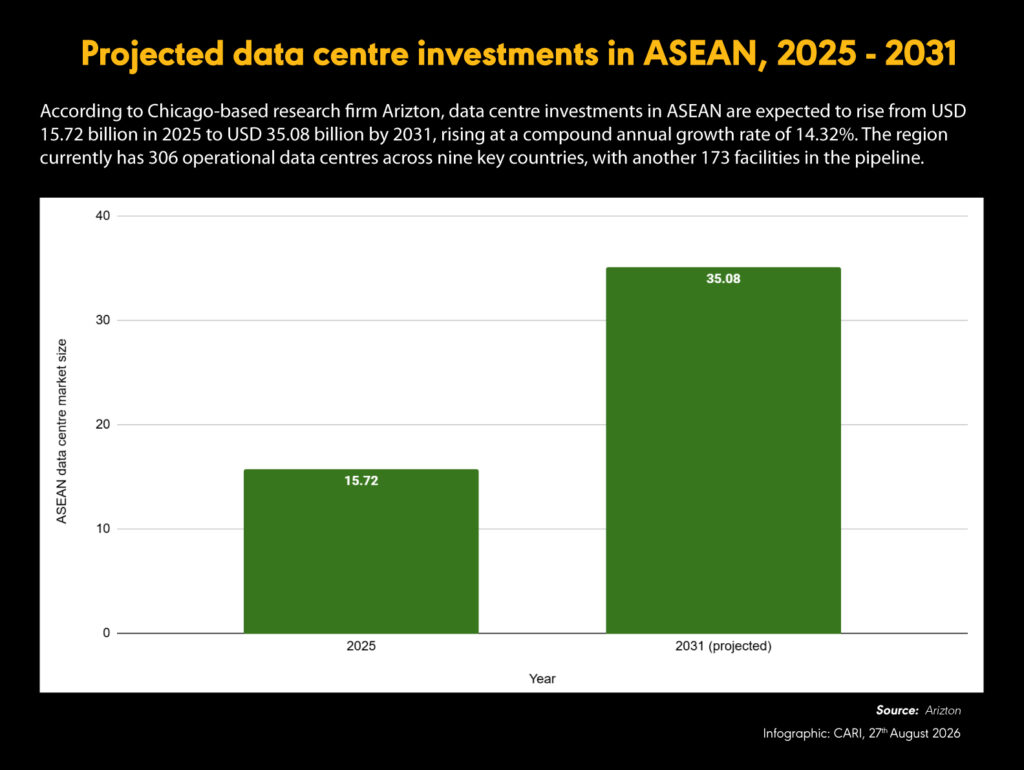
ASEAN data centre investments to increase from USD 15.72 billion in 2025 to USD 35.08 billion in 2031
(25 August 2026) According to Chicago-based research firm Arizton, Southeast Asia has 306 operational data centres and 173 in the pipeline, while regional data centre investment is forecast to increase from USD 15.72 billion in 2025 to USD 35.08 billion by 2031, a 14.32% CAGR. Arizton forecasts 1,435 MW of regional capacity and 5.83 million sq ft of white-floor space by 2031. Malaysia has the largest announced pipeline, exceeding 6 GW of IT load, including about 4.0 GW in Johor as of November 2025, of which 700 MW was under construction and 3.3 GW remained planned or announced. Malaysia’s market is forecast to reach USD 11.40 billion and 679 MW by 2031, supported by lower electricity and construction costs than Singapore and investment incentives. However, new data centre tariffs introduced in July 2025 could increase energy costs by 10–14%, with facilities above 100 MW facing an additional USD 15–20 million in annual costs. Singapore has 45 operational data centres and six upcoming facilities, with future development focused on efficiency and density; it also approved a 700 MW low-carbon data centre park on Jurong Island last October. Thailand is forecast to be the fastest-growing market, rising from USD 1.44 billion to USD 6.28 billion by 2031 at 27.78% CAGR, with a pipeline exceeding 2.87 GW and four projects approved for about 376 MW last November. Indonesia is forecast to grow from USD 2.82 billion to USD 6.09 billion by 2031 and has 88 operational and 25 upcoming facilities, with Batam attracting cloud and AI infrastructure investment including a planned 360 MW Firmus facility. Arizton expects regional AI computing requirements to increase nearly tenfold by 2030, driving capacity to almost triple, while submarine connectivity is also expanding across Singapore, Indonesia and Malaysia.
VIET NAM, AUSTRALIA
Viet Nam and Australia focusing on strengthening bilateral trade and investments
(26 August 2026) The Australia-Vietnam Policy Institute Forum in HCM City on 25 August focused on strengthening bilateral trade and investment to support Viet Nam’s rapid growth agenda. The Australian Consul-General said Viet Nam recorded 8% growth in 2025 and is shifting towards innovation-led growth, with Resolution 10 prioritising high-quality investment, skills development, technology transfer and national resilience. Australia aims to become a trusted long-term economic partner and identified the Australia-Vietnam Comprehensive Strategic Partnership and South-East Asia Economic Strategy to 2040 as key policy frameworks for deeper cooperation. The Permanent Vice Chairman of the HCM City People’s Committee, said leaders reaffirmed bilateral priorities in the economy, trade, investment, and science, technology and innovation during General Secretary To Lam’s 9–12 August visit to Australia. The Vice Chairman said the National Assembly’s passage of the Urban Development Law on 24 August provides a legal framework to mobilise domestic and international resources for urban and special economic zone development, potentially supporting greater Australian investment in HCM City.
VIET NAM, MYANMAR
Viet Nam and Myanmar agree to raise bilateral trade to USD 1 billion from USD 591 million in 2025
(27 August 2026) Viet Nam and Myanmar agreed to raise bilateral trade to USD 1 billion from USD 591 million in 2025, an increase of about 69%, during the Vietnamese Foreign Minister’s visit to Naypyidaw. Two-way trade reached USD 395 million in the first seven months of 2026, up 25% year on year, indicating a recovery from USD 591 million in 2025 and USD 873.9 million in 2018. The two countries had previously approached the USD 1 billion target, with trade reaching USD 952 million in 2019. Myanmar pledged favourable conditions for Vietnamese companies, particularly in telecommunications, education and training, agriculture and food processing. Vietnamese firms already operating in Myanmar include Mytel, BIDV and Hoang Anh Gia Lai. The two sides also agreed to simplify customs procedures and expand cooperation in telecommunications, agriculture and digital transformation. They will reconvene their Joint Committee on Bilateral Cooperation in 2027, the first such meeting since 2019. Myanmar President Min Aung Hlaing thanked Viet Nam for supporting Myanmar’s cooperation with ASEAN. The visit was Le Hoai Trung’s first bilateral visit to Myanmar since the 2021 military takeover.
MALAYSIA
Malaysia mulling regulations for e-commerce platforms, including registration requirements
(26 August 2026) Malaysia is considering immediate measures to regulate e-commerce platforms, including a registration requirement, following complaints from users and merchants. Malaysia’s Communications Minister said on 26 August that some platforms operating in Malaysia have not registered their companies locally, although he did not identify them. Prime Minister Anwar Ibrahim instructed the Finance and Communications Ministries to examine regulatory measures during a Cabinet meeting. Malaysia’s internet regulator has received 1,964 complaints about e-commerce platforms since January 2025, covering scams, electrical and electronic products, and halal certification issues. Fahmi said enforcement would begin immediately but did not provide details of the proposed measures. Popular platforms in Malaysia include Shopee, TikTok Shop and Lazada.
MALAYSIA
Business confidence for third quarter of 2026 improves to 5.9% from -1.8% in previous quarter
(27 August 2026) The Department of Statistics Malaysia (DOSM) reported that business confidence for 3Q2026 improved to 5.9%, from negative 1.8% in 2Q2026, with all major sectors recording stronger readings except for a slight easing in services. Industry posted the largest improvement, rising to 8.2% from negative 3.7%, while construction moved to 4.1% from negative 9.5% and wholesale and retail trade to 1.2% from negative 7.5%. Services remained positive at 5.2%, compared with 6.2% previously. The overall six-month outlook also strengthened, with the net balance increasing to 12.9% from 7.9%. Construction had the strongest six-month outlook at 23.3%, followed by industry at 14.3%, services at 13.1% and wholesale and retail trade at 5.3%. For 3Q2026 revenue, 31.9% of businesses expect an increase, 47.4% expect no change, and 20.7% anticipate a decline. Employment expectations remained broadly stable, with 78.3% of businesses expecting no change in workforce, while 13.9% plan to increase hiring and 7.8% expect reductions. At the state level, Terengganu recorded the highest confidence reading at 10.5%, followed by Kuala Lumpur at 9.5% and Negeri Sembilan at 9.4%. Melaka and Labuan were the only states with negative readings, at negative 3.9% and negative 5.4% respectively.
THAILAND
Bank of Thailand keeps policy rate unchanged at 1.00% on 26 August
(26 August 2026) The Bank of Thailand’s monetary policy committee unanimously kept its policy rate at 1.00% on Wednesday, marking the third consecutive meeting without a change. The decision reflects subdued domestic demand, high household debt and weak, below-potential growth, which give policymakers scope to prioritise economic recovery despite higher energy costs linked to the Middle East conflict. The BOT said exports and investment have benefited from the technology and artificial-intelligence cycle, but these gains rely heavily on imported inputs and have limited spillovers to the wider economy. The central bank forecasts GDP growth of 2.3% in 2026 and 1.8% in 2027. It now expects headline inflation to be lower than previously assessed because of fluctuations in global energy prices, compared with earlier forecasts of 2.8% in 2026 and 1.4% in 2027. The BOT will monitor the Middle East conflict, the extent to which businesses pass higher costs to consumers and medium-term inflation expectations. The committee said the current 1.00% rate remains appropriate to support economic recovery. Capital Economics expects rates to remain unchanged for the rest of 2026, with easing potentially resuming in 2027 if inflation declines as forecast.
THE PHILIPPINES
Companies adjusting as inflation and weak growth pressures consumer spending
(26 August 2026) Philippine companies are adjusting pricing, product inputs, expansion and promotions as inflation, a weak peso and subdued growth pressure consumer spending. Shakey’s Pizza Asia Ventures reported a one-third decline in first-half profit and is slowing expansion, becoming more selective on investment and restructuring its Peri-Peri chicken chain. Jollibee Foods cut its same-store sales, profit-growth and outlet-opening forecasts despite improved customer visits in April–June, while retaining lower-priced Mix & Match meals and implementing a PHP 2.8 billion-peso cost-containment programme. Monde Nissin is switching to lower-cost ingredients and staggering 1–5% price increases by product. Century Pacific Food raised prices 4–5% after holding them unchanged for two years and plans smaller increases in the third quarter. San Miguel Food and Beverage is controlling costs, expanding capacity where demand is stronger, and maintaining lower-priced food lines. PLDT’s Smart Communications increased selected prepaid packages to PHP 109 from PHP 99 while adding data and benefits, while PLDT Home introduced additional lower-cost broadband speed options. Globe Telecom is using free service periods, speed upgrades, and targeted discounts, including 30 days free, triple speeds and PHP 100 discounts for selected customers. Philippine Seven expects to benefit from consumers shifting towards cheaper products and nearer stores, and is expanding provincial branches while increasing its focus on ready-to-eat food and proprietary drinks.
RCEP Monitor
AUSTRALIA
Household spending rises 1.1% month-on-month in July 2026
(27 August 2026) Australian household spending rose 1.1% month on month in July, almost four times the 0.3% economist forecast, according to Australian Bureau of Statistics data. Spending was 7% higher than a year earlier, compared with an expected 5.7% increase. The figures indicate continued consumer demand despite the Reserve Bank of Australia’s three interest-rate increases at the start of 2026. The RBA has since held its policy rate at 4.35% at its past two meetings while seeking to reduce inflationary pressure. The stronger spending data, following a higher-than-expected inflation reading on Wednesday, has increased expectations that the RBA could raise rates again as early as September. Oxford Economics Australia said continued household spending strength would concern the RBA, although falling house prices and the prospect of further rate rises could weaken demand. July unemployment also increased, suggesting some easing in labour-market conditions. Markets and economists will assess next week’s second-quarter GDP data and subsequent labour-market figures for further indications of the RBA’s policy direction.
JAPAN
Authorities mulling using tax incentives to encourage retail purchases of government bonds
(27 August 2026) Japan is considering tax incentives to increase individual purchases of government bonds, potentially shifting household wealth from bank deposits into sovereign debt. Proposals include inheritance-tax breaks for Japanese government bond holdings and a Democratic Party for the People (DPP) bill to allow government bonds in NISA tax-free investment accounts. As of March, households held about JPY 20 trillion (USD 125 billion) in government bonds against JPY 1 quadrillion in bank savings, according to Bank of Japan data. The five-year bonds due for issuance in September will carry a 2.06% coupon, compared with about 1% on five-year fixed deposits at major banks. Retail government bond sales reached about JPY 4 trillion between April and August, up 66% year on year. Japan’s Finance Minister said making government bonds more attractive to retail investors was necessary for stable issuance and redemption as the BOJ reduces its bond purchases. Mizuho Securities estimated that inheritance-tax incentives could trigger reallocations of tens of trillions of yen or more than JPY 100 trillion, particularly among wealthy households. He noted that shifting bank savings into government bonds could reduce commercial banks’ capacity to buy government debt, limiting any net increase in overall demand. The NLI Research Institute also noted that NISA is intended primarily to redirect savings towards equities and provide companies with growth capital, rather than support government financing. Daiwa Institute of Research warned that large tax incentives would create a fiscal cost.
SOUTH KOREA
Bank of Korea raises benchmark interest rate by 0.25 percentage points to 3% on 27 August
(27 August 2026) The Bank of Korea raised its benchmark rate by 0.25 percentage points to 3% on 27 August, with six of seven Monetary Policy Committee members supporting the increase. The move followed a similar 0.25-point increase in July and ended a period in which rates had remained at 2.5% since May 2025. The BoK raised its core inflation forecasts to 2.5% for both 2026 and 2027, from 2.4% and 2.3% respectively. It also upgraded GDP growth forecasts to 3.3% for 2026 and 2.9% for 2027, from 2.6% and 2.1%, driven by strong semiconductor exports and investment and a gradual consumption recovery. The central bank warned that stronger household incomes could increase demand-side inflation and highlighted rising metropolitan housing prices and household debt as risks. The BOK’s Governor said the latest increase was intended to address inflation before stronger measures became necessary. The BoK’s new dot plot indicated a slower pace of further tightening, with 10 of 21 projections pointing to a 3.25% rate in six months, six to 3.5% and five to 3%. The won strengthened to KRW 1,379 per US dollar following the decision, while the Kospi rose 1.58%. Meanwhile, the government expects 2027 national tax revenue to exceed KRW 500 trillion (USD 362 billion), up from a previous KRW 412 trillion forecast, supporting plans for a Future Response Fund targeting AI and other strategic industries.
|
15 participating countries |
20 chapters |
2.2 billion |
US$26.2 trillion |
28% |
| ASEAN member states, Australia, China, Japan, South Korea, New Zealand | trade in goods and services, investment, intellectual property, e-commerce, competition, SMEs, economic and technical cooperation, and government procurement | combined population, 30% world’s population | combined GDP, 30% global GDP | global trade (based on 2019 figures) |