


CARI Captures Issue 775: Thailand’s GDP grows 2.9% year-on-year in the third quarter of 2026
Captures has widened its scope to include news related to all the members of the Regional Comprehensive Economic Partnership (RCEP) agreement which was signed towards the end of 2020. Besides the ASEAN Member States, this includes Australia, New Zealand, China, Japan, and South Korea. The other weekly newsletters under CARI, China-ASEAN Monitor and Mekong Monitor will also be consolidated into the Captures newsletter. We hope this new version of Captures will serve you better and look forward to providing a curation of stories relevant to ASEAN and its trading partners.
THAILAND
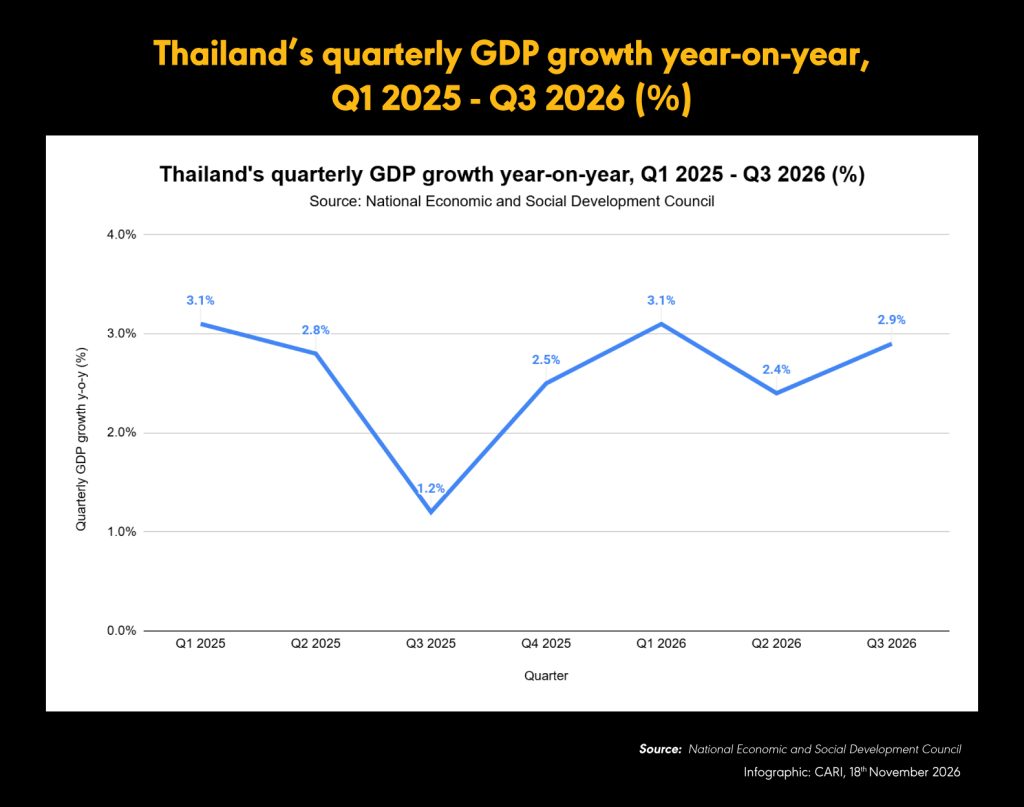
Thailand’s GDP grows 2.9% year-on-year in the third quarter of 2026
(16 November 2026) Thailand’s GDP grew 2.9% year-on-year in the third quarter of 2026, up from revised growth of 2.4% in the second quarter, according to the National Economic and Social Development Council on 16 November, although below the 3.1% market forecast. Growth was supported by the global AI investment cycle, with exports increasing 18.3% and investment growth accelerating to 11.8%, particularly in electronics and advanced technology. Household consumption rose only 2.5%, while government spending contracted 1.6%, highlighting continued weakness in domestic demand. The expansion lifted Thailand ahead of the Philippines, which recorded 2.1% growth, but remained below Viet Nam’s nearly 10% growth and the more than 5% growth recorded in Indonesia, Singapore and Malaysia. The stronger performance partly reflected a favourable base effect following trade disruptions caused by US tariffs and the Thailand-Cambodia border conflict a year earlier. Thailand has attracted increased investment in AI, data centres and advanced electronics, alongside renewed foreign investment in its bond and equity markets. Prime Minister Anutin Charnvirakul’s governing coalition has also provided greater political stability and room to pursue investment and economic policies, although a no-confidence vote is expected next month amid continuing street protests.
INDONESIA
Indonesian rupiah falls 0.4% to record low against US dollar
(16 November 2026) The Indonesian rupiah fell 0.4% to a record low of 18,271 per US dollar on 16 November, bringing its depreciation to approximately 9% this year and making it one of the region’s weakest-performing currencies. The decline reflects a stronger US dollar amid expectations of Federal Reserve interest-rate hikes, domestic political uncertainty under President Prabowo Subianto, departures of key policymakers, and concerns over MSCI’s potential downgrade of Indonesia’s equity market to standalone status. Vice President Gibran Rakabuming Raka’s resignation has further weakened investor confidence. Bank Indonesia (BI) has intervened in spot and onshore and offshore non-deliverable forward markets, while purchasing government bonds in the secondary market to contain volatility and support the rupiah. BI is expected to maintain its policy rate unchanged at its Wednesday meeting, with Credit Agricole CIB indicating that the central bank is likely to consider the currency’s depreciation consistent with economic fundamentals and retain its current monetary policy stance.
INDONESIA
Indonesia announces that at least 70% of benefits generated by mining must accrue to the state
(16 November 2026) Indonesian President Prabowo Subianto announced that at least 70% of the benefits generated by all mining permits and licences must accrue to the state, effective immediately, and indicated that the government could take control of company shares if necessary. He made the announcement during a speech in Palu, Sulawesi, on 14 November but did not clarify whether the requirement applies to existing as well as new permits. The Government Communication Agency had not provided clarification on the policy’s scope. The proposal forms part of Prabowo’s efforts to strengthen state control over the commodities sector, following the seizure of mines and millions of hectares of palm oil plantations and the imposition of substantial fines on their owners. His administration previously proposed greater state control over commodity exports but subsequently scaled back the initiative. Indonesia already maintains state participation in major mining operations, including stakes in mines operated by Freeport McMoRan and Vale, which were transferred to the state under former President Joko Widodo. Prabowo has adopted a more interventionist approach, including an unsuccessful attempt in January to take over a Sumatran gold mine ultimately controlled by Jardine Matheson Holdings over alleged links to severe flooding.
MALAYSIA, THAILAND
Crackdown on illegal foreign property ownership in Thailand sees shift among foreign buyers to Malaysia
(16 November 2026) Thailand’s year-long crackdown on illegal foreign property ownership has resulted in property confiscations, arrests and prosecutions, leaving some foreign owners facing forced sales within 12 months. The Commerce Ministry reported in June that 140 accountants were under investigation over 2,040 foreign-linked companies, with one accountant reportedly holding shares in 212 companies worth THB 247 million (USD 7.3 million). Authorities are targeting nominee arrangements in which Thai nationals hold 51% of companies on behalf of foreign investors, bypassing restrictions on foreign land ownership and majority company ownership. Foreigners may legally hold registered leases of up to 30 years or own condominium units outright, subject to the 49% foreign ownership limit for each building. The crackdown has affected retirees and business investors who believed they had legitimate ownership arrangements, with some facing property confiscation or distressed sales. Reduced buyer demand is putting pressure on developers reliant on off-plan sales, with property agents warning of potential bankruptcies among heavily leveraged companies. Even condominium developments complying with foreign ownership limits could face stricter scrutiny. Malaysia could benefit from the shift, as foreigners can purchase residential property, including freehold land, in their own names, subject to minimum price thresholds and state approval. Malaysia My Second Home (MM2H) received 7,650 applications between October 2024 and August 2026, generating MYR 8.85 billion in economic value, including more than MYR 5 billion in property purchases. Revised MM2H requirements introduced in 2024 set minimum property values of MYR 600,000 for the five-year renewable Silver tier and MYR 2 million for the 20-year renewable Platinum tier, although higher financial requirements and agent fees have raised concerns about affordability for middle-income applicants.
VIET NAM
Viet Nam’s silver economy could contribute more than USD 5.6 billion to GDP
(16 November 2026) Viet Nam’s silver economy could contribute more than USD 5.6 billion to GDP, equivalent to 1.1% of the 2025 economy, according to an Asian Development Bank estimate presented at a policy dialogue on 16 November. The country has nearly 17 million people aged 60 and above, representing approximately 16% of the population, and is expected to become an aged society by 2034, with this demographic exceeding 20 million. The golden population period is projected to end around 2036, leaving Viet Nam approximately a decade to prepare its institutions, infrastructure and social security systems. Nearly nine million older people are already engaged in employment, production and business activities. Investment opportunities include healthcare, pharmaceuticals, rehabilitation, nutrition, assistive technologies, elderly care, housing, financial services and leisure. However, Viet Nam currently has only around 100 hospitals with geriatric departments and 220 elderly care facilities serving approximately 15,000 people, alongside shortages of specialised healthcare and care workers. The Health Ministry identified community-based healthcare, preventive treatment and expanded long-term care as priorities, noting that people aged 60 and above could account for 25% of the population by 2050. World Bank research cited at the dialogue warned that workforce contraction could reduce annual economic growth by approximately 0.9 percentage points, while demographic pressures could increase social insurance costs during 2028–2034.
SINGAPORE
AI to reshape Singapore’s USD 7 trillion wealth management sector
(17 November 2026) Singapore’s Minister of State for Foreign Affairs and National Development said the country must leverage artificial intelligence (AI) to generate wealth and strengthen its position as a global financial centre while maintaining strong regulatory safeguards. Speaking at the HSBC Singapore Wealth Investment Summit 2026 on 17 November, he said Singapore would focus on AI research, development and commercial applications rather than competing with global technology giants in developing advanced models. The wealth management sector has grown to USD 7 trillion in assets under management, while private banking client assets increased by approximately 50% over five years and the country now hosts around 2,000 single-family offices. The financial sector contributes 14% of GDP and employs approximately 200,000 people. The minister identified five priority areas for AI applications: connectivity, advanced manufacturing, healthcare, housing development and financial services. In wealth management, AI could reduce the preparation of client portfolio reviews from several hours to minutes by consolidating information across banking divisions. Around 30 financial institutions, including HSBC, have established AI centres of excellence in Singapore, developing applications such as tokenised money market funds, agentic commerce and AI-powered advisory services. Singapore is also strengthening its capital markets through initiatives targeting equities trading, gold trading and growth capital funding for start-ups.
CAMBODIA
Trade with RCEP members increases 20.5% year-on-year to USD 39.68 billion in January-October 2026 period
(17 November 2026) Cambodia’s trade with Regional Comprehensive Economic Partnership (RCEP) members increased 20.5% year-on-year to USD 39.68 billion in January-October 2026, compared with USD 32.93 billion a year earlier, according to the Ministry of Commerce. Exports rose 8% to USD 8.8 billion, while imports increased 24.5% to USD 30.88 billion. RCEP members accounted for 61% of Cambodia’s total global trade of USD 65 billion during the period. China, Viet Nam, Singapore, Japan and Thailand were Cambodia’s five largest trading partners within the bloc. Cambodia’s Ministry of Commerce attributed the growth to preferential tariffs and trade facilitation, describing RCEP as a key driver of long-term trade expansion and foreign direct investment. They said RCEP, alongside other bilateral free trade agreements, would support Cambodia’s ambition to graduate from least developed country status by 2029, become an upper-middle-income economy by 2030 and achieve high-income status by 2050.
RCEP Monitor
SOUTH KOREA, INDONESIA
Indonesia pushes for closer semiconductor ties between ASEAN and South Korea
(17 November 2026) Indonesian President Prabowo Subianto called on ASEAN to develop critical mineral processing industries to strengthen its role in South Korea’s semiconductor supply chain, during the 27th Asean-Republic of Korea Summit in Manila on 16 November. He identified downstream mineral processing, semiconductor production, artificial intelligence research and skills development as priorities for technological cooperation, highlighting the ASEAN-Korea High-Performance Computing Facility as an existing initiative. Prabowo also urged stronger economic integration through the Regional Comprehensive Economic Partnership (RCEP) and an upgrade of the Asean-South Korea Free Trade Area to expand market access and digital trade opportunities. ASEAN-South Korea merchandise trade exceeded USD 226 billion in 2025, making South Korea the bloc’s sixth-largest trading partner. He also proposed cooperation on renewable energy, clean technology, maritime surveillance and law enforcement to strengthen energy security and protect regional trade routes, alongside renewed dialogue to ease tensions on the Korean Peninsula. South Korean President Lee Jae-myung reaffirmed support for ASEAN centrality and highlighted progress in police and maritime police cooperation to combat transnational crime, including online scams and maritime threats. Negotiations to upgrade the South Korea-ASEAN free trade agreement have commenced, with both sides targeting annual bilateral trade of USD 300 billion. The 2026-2030 plan of action will provide the framework for strengthening the strategic partnership.
JAPAN, MALAYSIA
Malaysia calls for early comprehensive review of ASEAN-Japan Comprehensive Economic Partnership
(17 November 2026) Malaysia called for an early comprehensive review of the ASEAN-Japan Comprehensive Economic Partnership to reduce trade barriers, expand market access and strengthen opportunities for small and medium enterprises (SMEs). Prime Minister Anwar Ibrahim, in a speech delivered by Malaysia’s Foreign Minister at the 29th ASEAN-Japan Summit on 17 November, identified three priorities for bilateral and regional cooperation: economic resilience and business opportunities, local artificial intelligence (AI) capabilities, and regional energy connectivity. Anwar called for investment in local AI talent to support business innovation and improve public services, alongside strong governance and regulatory frameworks that respect national sovereignty and domestic laws. He also urged accelerated development of the ASEAN Power Grid to enable cross-border renewable energy trade. Japan’s investment and technical expertise were identified as important to modernising regional electricity infrastructure and supporting a secure energy transition.
AUSTRALIA
Australia hit by worst property slump in 40 years, offset by consecutive interest rate increases
(17 November 2026) Australian property prices have fallen 10.1% in Sydney since the start of 2026, with declines of 7.9% in Melbourne, 3.6% in Brisbane and 6.6% across all capital cities, marking the country’s most severe downturn in 40 years. Five consecutive interest rate increases since February raised borrowing rates from 3.6% to 4.85%, reducing buyers’ borrowing capacity despite lower property prices. The value of new home loans fell 15% in the three months to September, the largest decline on record, while borrowing by first-home buyers dropped 8%, and investor lending fell 32%. Investor demand weakened following May’s tax reforms abolishing negative gearing and replacing the 50% capital gains tax discount with an inflation-based discount from 1 July 2027. AMP said lower property prices had largely been offset by higher borrowing costs, although buyers with secured financing and sufficient deposits could benefit from reduced competition and vendor discounts of up to 10%. Commonwealth Bank expects capital-city property prices to fall a further 15% in 2027. CBA expects the market to stabilise in the second half of 2027, supported by lower prices, higher rental yields, limited housing supply and an eventual easing of monetary policy. Foreign investors may also find purchasing opportunities, although uncertainty over further price declines is discouraging market entry.
|
15 participating countries |
20 chapters |
2.2 billion |
US$26.2 trillion |
28% |
| ASEAN member states, Australia, China, Japan, South Korea, New Zealand | trade in goods and services, investment, intellectual property, e-commerce, competition, SMEs, economic and technical cooperation, and government procurement | combined population, 30% world’s population | combined GDP, 30% global GDP | global trade (based on 2019 figures) |