


CARI Captures Issue 774: Viet Nam’s GDP per capita projected to surpass Indonesia in 2026, ranking fifth in ASEAN
Captures has widened its scope to include news related to all the members of the Regional Comprehensive Economic Partnership (RCEP) agreement which was signed towards the end of 2020. Besides the ASEAN Member States, this includes Australia, New Zealand, China, Japan, and South Korea. The other weekly newsletters under CARI, China-ASEAN Monitor and Mekong Monitor will also be consolidated into the Captures newsletter. We hope this new version of Captures will serve you better and look forward to providing a curation of stories relevant to ASEAN and its trading partners.
VIET NAM, INDONESIA
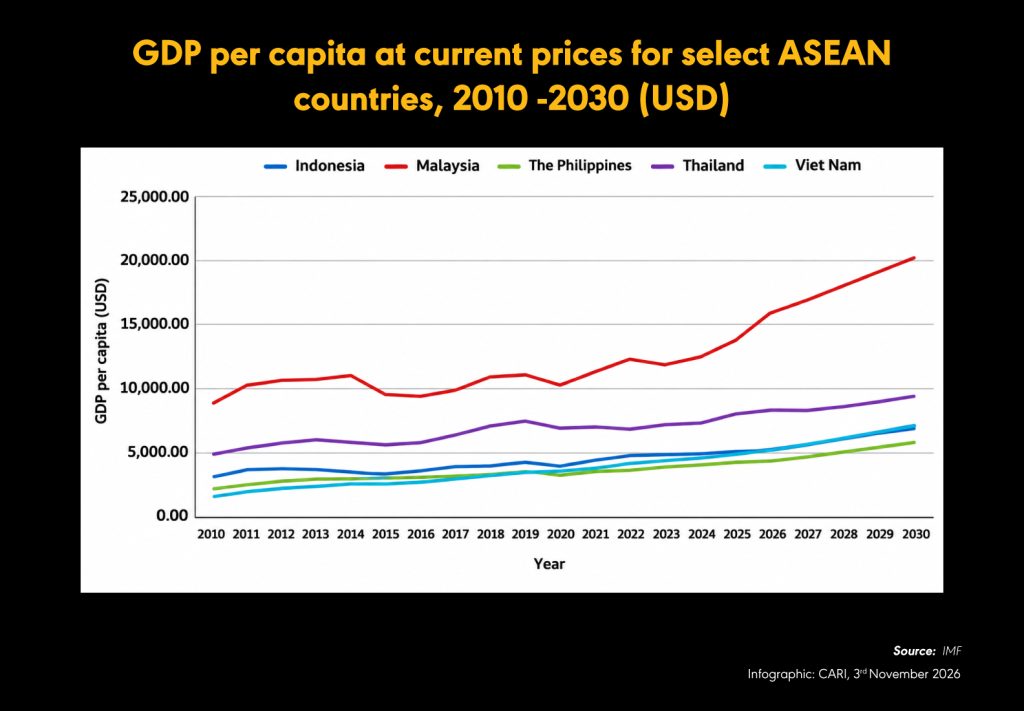
Viet Nam’s GDP per capita projected to surpass Indonesia in 2026, ranking fifth in ASEAN
(30 October 2026) Viet Nam’s nominal per capita GDP is projected by the IMF to increase 8.9% to USD 5,259 in 2026, surpassing Indonesia’s USD 5,153 and ranking fifth in ASEAN, behind Thailand. Viet Nam’s per capita GDP has nearly doubled over the past decade, supported by infrastructure spending and expanding high-tech manufacturing, particularly semiconductors and electronics. Real GDP grew 9.95% in the quarter ended September, while the government targets at least 10% growth for 2026. Public investment increased 46% year-on-year in January-September, with the government allocating VND 1 quadrillion (USD 38.7 billion) for the full year to infrastructure projects. Foreign direct investment (FDI) rose 12% to USD 21.1 billion, while registered FDI commitments increased 76% to USD 50.3 billion. Foxconn is expanding production in northern Viet Nam, while Samsung Electronics operates manufacturing facilities supplying smartphones and other electronics for export. Exports increased 25% to USD 434.3 billion in January-September. The US goods trade deficit with Viet Nam reached approximately USD 160 billion in January-August, exceeding its deficits with China and Mexico. Viet Nam aims to raise per capita GDP to USD 8,500 by 2030, although the IMF and Asian Development Bank project economic growth of around 7.5% in 2027. Long-term growth will require improvements in human capital and technological capabilities alongside continued infrastructure investment.
VIET NAM
Total trade turnover reaches estimated USD 1.01 trillion in first ten months of 2026
(02 November 2026) Viet Nam’s total trade turnover reached an estimated USD 1.01 trillion in the first 10 months of 2026, up 32.3% year on year, with exports increasing 27.4% to approximately USD 499 billion. Processed and manufactured industrial products accounted for 87.4% of total export value, according to the Ministry of Industry and Trade. October trade turnover reached USD 122.2 billion, up 47.6% year on year, generating a USD 6.8 billion surplus and narrowing the cumulative trade deficit to approximately USD 12.7 billion. The ministry is drafting a new import-export strategy covering 2030, with a vision to 2045, targeting an increase in domestic enterprises’ share of national exports to 30% by 2030 and 40% by 2045.
THAILAND, MYANMAR
Thailand increasingly employing Myanmar refugees to address labour shortages
(02 November 2026) Thailand is increasingly employing Myanmar refugees to address labour shortages, particularly following the departure of Cambodian workers amid the 2025 Thailand-Cambodia border conflict. The government lifted restrictions on refugees working outside camps in October 2025, providing a legal employment pathway for approximately 80,000 refugees residing in nine camps along the Myanmar border. By June 2026, around 1,800 refugees had secured jobs in agriculture, construction and manufacturing. Thanapa Construction has employed approximately 140 refugees, primarily to replace Cambodian workers who returned home, with the company’s founder citing their work ethic and ability to learn quickly. At a data centre construction site east of Bangkok employing around 5,000 workers, approximately 100 Myanmar refugees work eight-hour shifts, six days a week. Thailand’s Department of Employment said the programme was helping ease labour shortages despite the relatively small number of participants. However, some workers have returned to refugee camps due to difficulties coping with high temperatures and physically demanding work. Thanapa Construction is working with employment support organisations to improve explanations of job requirements before placement, while also providing housing and skills training.
THAILAND
Thailand records 25.46 million foreign arrivals from January to October 2026, down 4.59% year-on-year
(02 November 2026) Thailand recorded 25.46 million foreign arrivals from January to October 2026, down 4.59% year-on-year, with visitor spending reaching THB 1.24 trillion. Weekly arrivals increased 7.31% to 538,661 during October 25–31, supported by a 13.60% rise in long-haul visitors to 227,153, marking five consecutive weeks of growth. Short-haul arrivals increased 3.14% to 311,508. The five largest weekly source markets were Malaysia (61,842), China (51,479), Russia (44,499), India (40,884) and the US (21,261). Russian arrivals increased 27.19% year-on-year, while Chinese arrivals rose 4%; Malaysian arrivals declined 1.41%. Indian arrivals fell following the end of the Maha Navami and Navaratri festivals, while French arrivals dropped 18.68% amid protests in France. China remained Thailand’s largest source market for the first 10 months, with 4.24 million visitors, followed by Malaysia (3.23 million), India (1.92 million), Russia (1.41 million) and South Korea (932,066). Thailand’s Tourism and Sports Minister expects long-haul arrivals to strengthen further during the winter holiday season. However, protests in Europe and flight reductions on certain routes, particularly from Russia, could constrain arrivals.
MALAYSIA
Manufacturing sector returns to expansion in October 2026, rising to 51.0 from 49.9 in September
(02 November 2026) Malaysia’s manufacturing sector returned to expansion in October, with the S&P Global Manufacturing Purchasing Managers’ Index (PMI) rising to 51.0 from 49.9 in September, its strongest improvement since April. New orders recorded their fastest growth in four-and-a-half years, supported by stronger demand for AI-related products and existing customers, while manufacturing output increased marginally for the first time in three months. Manufacturers increased hiring for the third consecutive month and resumed purchasing activity to support higher production and sales. However, supply chain disruptions persisted for an eleventh consecutive month, with port congestion contributing to delivery delays, while some firms drew on finished goods inventories to meet demand. Purchasing inventories increased for the second consecutive month. Higher transportation and raw material costs, partly linked to the Middle East conflict, intensified operating expenses and prompted manufacturers to raise selling prices. S&P Global said rising costs and economic and geopolitical uncertainties weakened business confidence to its lowest level since April. Nevertheless, S&P Global expects industrial production and GDP growth to continue in the fourth quarter, with momentum strengthening from the third quarter.
MALAYSIA, CHINA
Chinese delegation indicates potential investments totalling USD 15 billion across six sectors
(02 November 2026) A delegation of 58 Chinese businesspeople has indicated potential investments totalling USD 15 billion (MYR 61 billion) in Malaysia across six sectors: electrical and electronics (E&E) and semiconductors; specialised industrial materials and precision engineering; digital economy and technology infrastructure; food processing and halal products; health and pharmaceutical technology; and tourism. Malaysia’s Deputy Prime Minister said the proposed investments would prioritise high-value, technology-driven and automated industries rather than labour-intensive manufacturing. Chinese investors identified Malaysia’s skilled workforce, supported by technical and vocational education and training (TVET), and its position in international supply chains as advantages for E&E and semiconductor investments. Other areas of interest include copper foil, robotics, automation, data centres, cloud computing and artificial intelligence. However, Malaysia is not encouraging additional data centre developments due to existing capacity and is instead urging investors to partner with local companies or acquire existing facilities. Chinese dairy producers are also exploring technology-sharing and food-processing investments, while health and pharmaceutical companies are considering Malaysia as a production base for halal health products targeting West Asian markets. Investors have also expressed interest in developing resorts and hotels. Malaysia’s Deputy Prime Minister said business-matching sessions involving local companies, business associations, chambers of commerce and government agencies would be arranged to facilitate partnerships and explain investment incentives. The delegation is expected to continue discussions and identify cooperation opportunities during its one-to-two-day visit.
MYANMAR, UNITED STATES
US seeks to use peace negotiations in Myanmar to secure access to rare earth deposits
(02 November 2026) A US State Department strategy document outlines Washington’s plan to use peace negotiations in Myanmar to expand US influence and secure access to the country’s rare-earth deposits, currently exported mainly to China. The US mission aims to facilitate a ceasefire leading towards a lasting peace agreement by 2030, including at least three multi-stakeholder forums producing agreements or policy proposals on fiscal federalism and territorial demarcation. These initiatives are intended to create opportunities for US companies to access rare-earth resources and support efforts against online scam centres. The strategy marks a shift from years of US policy focused on isolating Myanmar’s military leadership, with recent engagement involving State Department intelligence official Michael Vance and the military-backed government led by Min Aung Hlaing. The document, approved on 31 August and published on 16 October, also prioritises improving the operating environment for US businesses and increasing US exports to reduce Washington’s trade deficit with Myanmar. The US embassy aims to secure at least three major commercial or investment deals worth more than USD 5 million each for American companies. Other priorities include law enforcement cooperation against scam centres targeting Americans and cooperation with Myanmar authorities to repatriate Myanmar nationals from the United States. However, the strategy does not specify whether Washington intends to ease sanctions or address other compliance barriers to investment.
RCEP Monitor
SOUTH KOREA
South Korea proposes record 2027 budget of KRW 820.9 trillion, up 12.8%
(02 November 2026) South Korean President Lee Jae Myung proposed a record 2027 budget of KRW 820.9 trillion (USD 610.14 billion), up 12.8%, with KRW 21.3 trillion allocated to semiconductors, physical AI and AI data centres, nearly double the 2026 allocation. A further KRW 4.7 trillion will fund development of a sovereign AI model targeting the world’s highest performance. The government will also train 2,000 specialists in semiconductor design and regional semiconductor industries and expand AI education for students, job seekers and existing workers. Lee said the spending increase would result in virtually no net rise in government debt, with newly issued bonds used to refinance existing debt. Defence spending will increase 8.2% to KRW 73.3 trillion, supporting AI-enabled military capabilities, robotics, drones and integrated manned-unmanned systems. The budget comes amid strong export growth, with October exports rising 93.7% year on year to a record USD 115.3 billion, driven largely by semiconductor demand. Exports reached USD 930 billion in the first 10 months of 2026, surpassing USD 900 billion for the first time, while October imports increased 36% to USD 72.8 billion, producing a USD 42.5 billion trade surplus. Lee said South Korea was approaching USD 1 trillion in annual exports.
SOUTH KOREA
Headline inflation eases to 2.8% year-on-year in October 2026
(03 November 2026) South Korea’s consumer price inflation eased to 2.8% year-on-year in October, from 2.9% in September, broadly matching the 2.85% forecast in a Reuters poll. The Consumer Price Index increased 0.2% month-on-month, compared with 0.3% in September. Despite the slowdown, inflation remained above the Bank of Korea’s 2.0% target. Elevated global energy prices and rising household borrowing continue to sustain inflationary pressures. A separate economist poll indicated expectations for the policy rate to peak at 3.50%, implying one further rate hike in November 2026 and another in the first quarter of 2027.
AUSTRALIA
Reserve Bank of Australia raises cash rate by 0.25 percentage points to 4.85%
(03 November 2026) The Reserve Bank of Australia (RBA) raised its cash rate by 0.25 percentage points to 4.85%, an 18-year high and its fifth increase in 2026, following a 6-3 vote. The RBA’s governor attributed the decision to a materially worsening inflation outlook, with fuel, commodities and AI-related investment contributing to price pressures. The RBA now expects inflation to return to its 2–3% target range only in late 2027, three quarters later than previously forecast. Underlying inflation reached 3.6% year on year in September, while headline inflation stood at 4.3%. The rate increase comes amid unemployment rising to 4.7% and falling house prices, adding pressure on Prime Minister Anthony Albanese’s government ahead of planned public spending cuts next month. The Australian dollar weakened by as much as 0.35% to below USD 0.70 following the announcement. HSBC Australia estimated a 50% chance of recession, although the RBA governor said the RBA’s baseline forecast did not anticipate one. AMP estimated that cumulative rate increases would add AUD 6,600 (USD 4,610) annually to mortgage interest payments for many homeowners, increasing financial pressure on borrowers. The RBA’s decision contrasts with recent rate holds by the US Federal Reserve, European Central Bank, Bank of Japan and Reserve Bank of New Zealand, with the RBA defending tighter policy as necessary to curb excess domestic demand.
|
15 participating countries |
20 chapters |
2.2 billion |
US$26.2 trillion |
28% |
| ASEAN member states, Australia, China, Japan, South Korea, New Zealand | trade in goods and services, investment, intellectual property, e-commerce, competition, SMEs, economic and technical cooperation, and government procurement | combined population, 30% world’s population | combined GDP, 30% global GDP | global trade (based on 2019 figures) |