


CARI Captures Issue 773: Climate damage to Philippines’ ports could rise to USD 70.2 billion by 2100
Captures has widened its scope to include news related to all the members of the Regional Comprehensive Economic Partnership (RCEP) agreement which was signed towards the end of 2020. Besides the ASEAN Member States, this includes Australia, New Zealand, China, Japan, and South Korea. The other weekly newsletters under CARI, China-ASEAN Monitor and Mekong Monitor will also be consolidated into the Captures newsletter. We hope this new version of Captures will serve you better and look forward to providing a curation of stories relevant to ASEAN and its trading partners.
THE PHILIPPINES
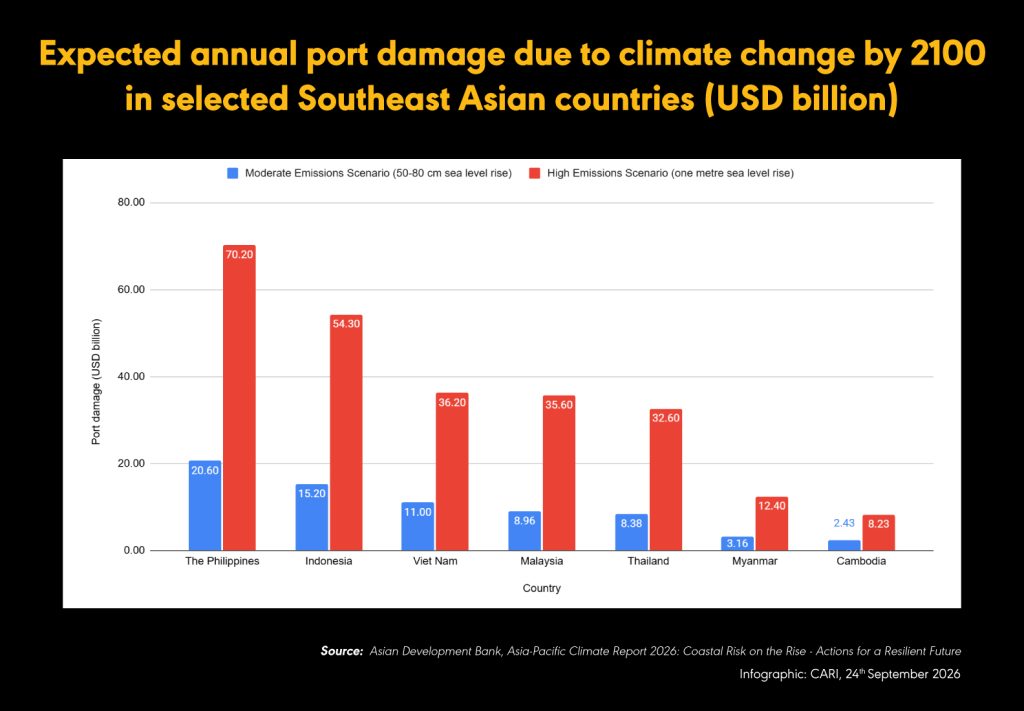
Climate damage to Philippines’ ports could rise to USD 70.2 billion by 2100
(26 October 2026) The Asian Development Bank’s Asia-Pacific Climate Report 2026: Coastal Risks on the Rise – Actions for a Resilient Future projects annual climate-related port damage costs in the Philippines of USD 20.6 billion under a moderate-emissions scenario with 50–80cm of sea-level rise, increasing to USD 70.2 billion under a high-emissions scenario with sea levels rising by up to one metre by 2100. The Philippines would face the highest projected costs in Southeast Asia, behind only China in the Asia-Pacific region. The estimates include port infrastructure repairs and losses from maritime trade disruption. Transport specialists warned that port damage could disrupt supply chains, increase food prices, delay shipments, raise logistics costs, and undermine livelihoods and disaster relief. Sea-level rise would compound risks from storm surges, stronger tropical cyclones, coastal erosion and flooding, while more than 20 typhoons affect the Philippines annually. Metro Manila’s main port complex and other coastal hubs, including Iloilo, Cebu, Batangas, Subic, Davao and Cagayan de Oro, face exposure to flooding and storm surges, with urban development outpacing drainage and protective infrastructure in some areas. The Philippine Ports Authority said in September that it was strengthening climate- and disaster-resilient infrastructure, conducting emergency drills and improving coordination to maintain port operations during typhoons and earthquakes.
INDONESIA, SINGAPORE
Indonesia reduces natural gas pipeline deliveries to Singapore to prioritize domestic demand
(24 October 2026) Indonesia reduced natural gas pipeline deliveries to Singapore by 31 million standard cubic feet per day (scfd) from Saturday for 18 days, redirecting supplies to meet domestic electricity demand. The chief of SKK Migas, the government agency overseeing Indonesia’s upstream oil and gas industry, said 15 million scfd from Natuna would be diverted to a state utility unit in Batam, while 16 million scfd from Sumatra would support electricity needs in Batam, Bintan and Sumatra. The reduction represents approximately 14% of Indonesia’s average pipeline gas exports to Singapore last year, but less than 2% of Singapore’s total daily gas demand. Singapore Prime Minister Lawrence Wong said on Sunday that commercial contracts must be honoured and that the country’s gas importer would protect its contractual rights and interests. Singapore’s Energy Market Authority said the country has sufficient energy supplies and contingency plans, with Singapore GasCo prepared to increase liquefied natural gas (LNG) imports if necessary. Gas Supply Pte confirmed that the temporary reductions had affected deliveries to its customers and that it was engaging with its supplier and customers to manage the disruption. Indonesia’s decision reflects President Prabowo Subianto’s policy of prioritising domestic energy security amid growing local demand and declining overseas shipments. Indonesia’s Coordinating Minister for Downstreaming and Energy Transition suggested Indonesia could consider not renewing gas export agreements with neighbouring countries to prioritise domestic requirements. The move follows a 16-hour blackout in Batam earlier this month that affected more than 411,000 customers and prompted the government to replace the chief executive of state-owned electricity company PT Perusahaan Listrik Negara.
INDONESIA
Indonesia introduces additional stock market reforms to address manipulation and opaque trading concerns
(26 October 2026) Indonesia introduced additional stock market reforms to address manipulation and opaque trading following MSCI’s warning that it could downgrade the country from emerging-market status to standalone status, a more severe classification than the frontier-market downgrade previously raised in January. The Indonesia Stock Exchange (IDX) will expand the committee identifying stocks with concentrated share ownership to include independent representatives, including Indonesian academics and F. Chapman Taylor, an adviser to sovereign wealth fund Danantara and former Capital Group partner. A financial regulator official urged the IDX to strengthen surveillance, detect coordinated trading, and improve responses to irregular transactions. From 2 November, the IDX will exclude stocks with highly concentrated shareholdings from its main Jakarta index; the current list covers 80 companies. From November, the exchange also plans to investigate suspected coordinated trading to manipulate share prices and freeze suspicious investor accounts, replacing its previous approach of issuing warnings and requesting company explanations. The policy allowing share buybacks without approval at a general shareholders’ meeting has been extended until June 2027, subject to minimum free-float requirements. Regulators are engaging with MSCI and FTSE Russell to demonstrate their commitment to market reforms, which have included greater disclosure of investor accounts and ownership data, higher minimum free-float requirements and record fines for market manipulation. MSCI’s warning triggered Indonesia’s deepest-ever two-day stock sell-off on 16 and 19 October, pushing the benchmark index to its lowest level since 2020 before a subsequent recovery.
INDONESIA
10-year government bond yields rise five basis points to 7.54%, highest level since October 2022
(27 October 2026) Indonesia’s 10-year government bond yield rose five basis points to 7.54% on 27 October, its highest level since October 2022, bringing its increase this year to more than 140 basis points. The rupiah approached its record low, trading within 0.2% of that level, while the benchmark stock index fell 2%, its largest daily decline in a week. Investor sentiment weakened amid elevated oil prices, rising government subsidy costs and MSCI’s warning that Indonesia could be reclassified to standalone market status, prompting concerns over foreign capital outflows. Demand at the 17 October government bond auction fell to a three-year low, with bids totalling IDR 31.1 trillion against an IDR 30 trillion target. The government sold at IDR 20.7 trillion, below its indicative target, as increased borrowing requirements weighed on demand. However, foreign holdings of Indonesian sovereign bonds increased by USD 509 million this month, indicating some demand for higher yields. PT Mandiri Sekuritas said MSCI’s warning would have a limited direct effect on bond yields but could create further risks if equity outflows continued to pressure the rupiah. They placed the 10-year yield’s fair-value range at 7.5%–7.7% and said yields could decline if risk aversion eased and oil prices fell. PT Shinhan Sekuritas Indonesia said Indonesian bonds remained relatively attractive due to their high real returns, although prevailing negative sentiment had yet to generate stronger international inflows.
MALAYSIA, VIET NAM, SINGAPORE
Viet Nam to supply offshore wind energy to Malaysia and Singapore through cross-border electricity project
(26 October 2026) Malaysia’s Petronas and Tenaga Nasional Bhd (TNB), through the MY Energy Consortium, will work with PetroVietnam Technical Services Corporation to develop a cross-border electricity project supplying offshore wind energy from Viet Nam to Singapore and Peninsular Malaysia. Malaysia’s Deputy Prime Minister and Energy Transition and Water Transformation Minister said Malaysian contractors could participate in developing transmission infrastructure, including undersea cables, while local engineers would gain experience in offshore wind energy projects. Malaysia could also help Viet Nam establish a renewable energy certificate exchange mechanism, which the minister said was essential to the project’s commercial viability. Singapore’s Energy Market Authority has granted conditional approval for Sembcorp Utilities and its consortium partners to import 1.3 gigawatts of electricity, including offshore wind power from Viet Nam and solar power from Malaysia. Electricity imports are targeted to begin by 2035, subject to regulatory approvals, power purchase agreements and financing arrangements. Approximately 30% of the electricity from the Vietnamese offshore wind project would be supplied to Peninsular Malaysia, with the remainder mainly transmitted to Singapore.
MALAYSIA
Malaysia’s palm oil inventories reach record 3.51 million tonnes in September amid record production
(27 October 2026) Malaysia’s palm oil inventories reached a record 3.51 million tonnes in September, alongside record production, with further output growth expected during the seasonal peak in October. In Sarawak, which accounts for more than a fifth of national output, storage tanks are nearing capacity as a stronger-than-expected harvest, high diesel and freight costs, and slower shipments strain logistics. Bintulu Port handles more than 90% of Sarawak’s exports, concentrating the surplus at a key shipping gateway. The oversupply is weighing on prices, with Kuala Lumpur palm oil futures falling by as much as 2.2% on 27 October, their steepest decline in more than a month. Lower prices have widened palm oil’s discount to competing vegetable oils, supporting exports to buyers such as India, but high inventories continue to limit price recovery. Government and industry representatives met last week to discuss measures to reduce stockpiles, including a possible waiver of crude palm oil export taxes to encourage overseas sales. Malaysia’s Plantation and Commodities Minister said industry proposals remain under consideration and require further discussion. SD Guthrie urged swift government action to prevent storage constraints from disrupting the supply chain and leaving farmers unable to sell fresh fruit. Prolonged shortages of storage space could force mills to reduce processing during the peak harvesting season, affecting plantations and smallholders. Some companies have brought additional mills online, while authorities are exploring the use of other ports in Sarawak to ease the bottleneck.
THAILAND
Thailand to introduce subsidies worth USD 1.5 billion to help households install solar panels
(26 October 2026) Thailand plans to introduce subsidies worth up to USD 1.5 billion to help households install solar panels, with cabinet approval expected on Tuesday and applications to open shortly afterwards. Thailand’s Finance Minister said the initiative aims to reduce reliance on imported energy and improve energy security. The programme will be funded through a THB 400 billion emergency borrowing package announced earlier this year to cushion the economic impact of the Middle East war. Government data for January–July 2026 showed that natural gas accounted for approximately 60% of Thailand’s electricity generation, while renewables contributed almost 11%. Declining domestic offshore gas production and reduced supplies from Myanmar have increased Thailand’s reliance on liquefied natural gas (LNG), which accounted for 32% of its natural gas supply during the period. Qatar, a major LNG supplier, has also experienced damage to its gas infrastructure amid the US-Israeli war with Iran. Thailand aims to generate 51% of its domestic electricity from renewable sources by 2037.
RCEP Monitor
SOUTH KOREA
South Korea surpasses 2025 annual record for foreign tourist arrivals on 27 October
(28 October 2026) South Korea surpassed its 2025 annual record of 18.94 million foreign tourist arrivals on 27 October 2026, with more than two months remaining in the year. The Ministry of Culture, Sports and Tourism recorded 18.91 million arrivals provisionally through 26 October, with a daily average of approximately 64,000 visitors. From January to September, arrivals increased 21.5% year-on-year to 17.11 million, compared with declines of 2.9% in Japan and 3.8% in Thailand and growth of 14.5% in Viet Nam. Visitors from Greater China rose 29.1%, including 5.47 million from mainland China, while Japanese arrivals increased 16.9% to 3.12 million. Arrivals from other parts of Asia, the Middle East, Europe, the Americas and Oceania each grew by approximately 15%. Tourism is expanding beyond Seoul, with entries through airports and seaports outside the capital region rising to 4.82 million from 3.74 million, while regional visits increased 19.7% to 64.72 million. International visitors’ card spending rose 47.7% to KRW 15.9 trillion (USD 11.88 billion), driven by shopping, accommodation, and medical and wellness services. If the current pace continues, monthly arrivals could reach approximately 1.94 million in November, taking the annual total above 20 million for the first time. The ministry attributed growth to the global popularity of Korean culture, increased flight capacity, relaxed visa rules, a supplementary budget prepared in response to the Middle East war and the elevation of the National Tourism Strategy Meeting to a presidential body. South Korea’s Culture Minister said the ministry would prioritise tourism quality alongside visitor numbers as it pursues an annual target of 30 million foreign visitors.
AUSTRALIA
Consumer price index rises 1.3% in third quarter of 2026, taking annual inflation to 3.9%
(28 October 2026) Australia’s consumer price index rose 1.3% in the third quarter of 2026, up from 0.6% in the previous quarter, taking annual inflation to 3.9%, above the Reserve Bank of Australia’s (RBA) 2% to 3% target. Annual trimmed mean inflation, the key underlying measure, reached a two-year high of 3.7%, while September headline inflation accelerated to 4.3%, its highest since March. September goods and services inflation reached 4.6% and 4.1% respectively, although new dwelling prices remained flat amid increased builder discounts. The Governor of the RBA warned that inflation remained too high and said policymakers would consider whether four interest rate increases this year were sufficient. Markets raised the probability of a further 25-basis-point increase from 69% to 88%, with the current cash rate at 4.6% ahead of the next meeting on 27 October. The Australian dollar gained 0.2% to USD 0.7036, while three-year government bond yields rose five basis points to 4.913%. Commonwealth Bank of Australia economists abandoned their forecast of no further increase, while expecting a potentially divided decision following September’s hike. Brent crude oil rose 10% during the quarter to above USD 110 a barrel, increasing concerns over fuel costs and broader inflation. The RBA Governor attributed persistent inflation partly to domestic capacity constraints and said labour market conditions remained tighter than previously assessed, despite unemployment reaching a five-year high of 4.7% in September. Citi forecast headline inflation could rise to 4.7% in October and warned that the cash rate could reach 5% or higher. Markets anticipate another increase in November, while pricing in an approximately 40% probability that the rate will reach 5.1% by early 2027.
SOUTH KOREA
South Korea’s GDP grew 3.4% year-on-year in third quarter of 2026, exceeding forecasts
(27 October 2026) South Korea’s GDP grew 1.0% quarter-on-quarter and 3.4% year-on-year in the third quarter of 2026, exceeding the Bank of Korea’s August forecast of 0.3% quarterly growth. Expansion was driven by strong demand for artificial intelligence-related semiconductors, with exports rising 2.3% quarter-on-quarter, supported by semiconductors, machinery and electrical equipment. Facility investment increased 4.1%, investment in intellectual property rose 2.3%, and construction investment edged up 0.7%, while private consumption declined 0.2%. The results put South Korea on track for its strongest annual economic growth in more than a decade, excluding the COVID-19 pandemic. South Korea’s Finance Minister forecast 2026 growth of 3.4% to 3.6%, compared with 1.0% in 2025, the weakest expansion since the pandemic. South Korea has benefited from the global AI boom and memory-chip shortages, with Samsung Electronics and SK Hynix accounting for approximately 80% of the global high-bandwidth memory market and 60% of the dynamic random-access memory market. September exports surged 83.5% year-on-year to USD 120.9 billion, with semiconductors accounting for nearly half of total shipments.
|
15 participating countries |
20 chapters |
2.2 billion |
US$26.2 trillion |
28% |
| ASEAN member states, Australia, China, Japan, South Korea, New Zealand | trade in goods and services, investment, intellectual property, e-commerce, competition, SMEs, economic and technical cooperation, and government procurement | combined population, 30% world’s population | combined GDP, 30% global GDP | global trade (based on 2019 figures) |