


CARI Captures Issue 770: Viet Nam’s GDP expands 9.95% year-on-year in Q3, fastest quarterly expansion in four years
Captures has widened its scope to include news related to all the members of the Regional Comprehensive Economic Partnership (RCEP) agreement which was signed towards the end of 2020. Besides the ASEAN Member States, this includes Australia, New Zealand, China, Japan, and South Korea. The other weekly newsletters under CARI, China-ASEAN Monitor and Mekong Monitor will also be consolidated into the Captures newsletter. We hope this new version of Captures will serve you better and look forward to providing a curation of stories relevant to ASEAN and its trading partners.
VIET NAM
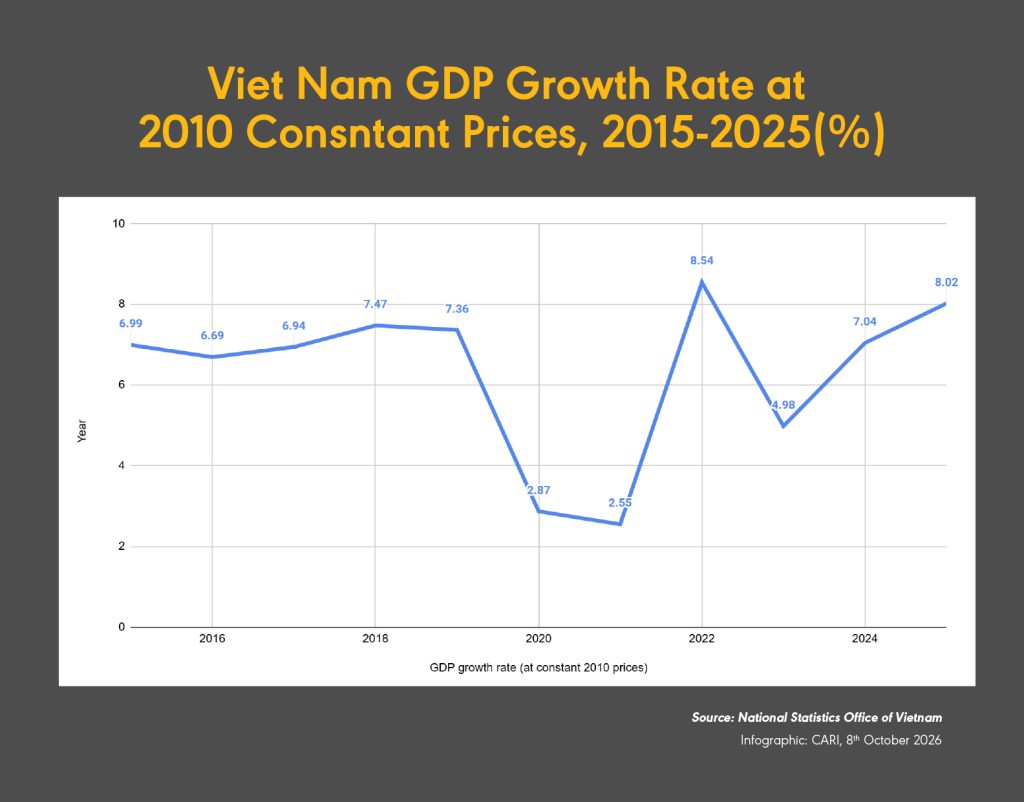
Viet Nam’s GDP expands 9.95% year-on-year in Q3, fastest quarterly expansion in four years
(03 October 2026) Viet Nam’s GDP grew 9.95% year-on-year in Q3, accelerating from revised 8.81% growth in Q2 and marking the fastest quarterly expansion in four years, supported by industry and construction. The National Statistics Office (NSO) revised Q1 growth to 8.15%, while nine-month GDP growth reached 9.01%. The economy would need to expand by at least 12.5% in Q4 to meet the government’s 10% full-year GDP target, according to the NSO’s National Accounts System Department. SSI Securities also assessed that Q4 growth of around 12% would be required and described the target as challenging. Key constraints identified by the National Accounts System Department include trade uncertainties, global supply-chain shifts, higher energy and input costs, and pressure to accelerate public investment disbursement. Q3 exports increased 30.4% year on year to USD 167.85 billion, while imports rose 42.2% to USD 170.33 billion. Viet Nam recorded a USD 19.42 billion trade deficit in January-September, with the US the largest export market at USD 140 billion and China the largest import source at USD 187.34 billion. September was the first month of 2026 to record a trade surplus, at USD 1.27 billion. September CPI increased 5.08% year-on-year, the highest in four months, while nine-month average inflation reached 4.5%, equal to the full-year ceiling set by the authorities. FDI inflows rose 12% year-on-year to USD 21.07 billion in January-September, the highest nine-month total in five years.
VIET NAM
Viet Nam attracts USD 50.36 billion in FDI in January-September 2026
(05 October 2026) Viet Nam attracted USD 50.36 billion in FDI in January-September 2026, up 76.4% year on year, including USD 29.24 billion in newly registered capital, 2.4 times the level a year earlier. Total social investment reached VND 3,109.6 trillion (USD 119.59 billion), up 15.1%, while state-budget investment increased 19%. Nine-month GDP growth reached 9.01%, with Q1, Q2 and Q3 expanding 8.15%, 8.81% and 9.95% respectively, led by industry and construction at 11.21%. Goods trade totalled USD 888.02 billion, up 30.4%, but the nine-month trade balance recorded a USD 19.42 billion deficit despite a USD 1.27 billion surplus in September. Retail sales rose 13.4% nominally to VND 5,925.7 trillion, while international visitors increased 14.5% to 17.7 million, equivalent to about 71% of the 2026 target. Average consumer price inflation reached 4.52%, slightly above the approximately 4.5% target. Nearly 149,700 new businesses were registered, up 3.2%, with registered capital increasing 32.7% to VND1,884.0 trillion. Youth unemployment rose 0.5 percentage points to 8.87%.
VIET NAM
Vietnamese banks planning USD 7 billion in share sales amid domestic funding squeeze
(07 October 2026) Vietnamese banks are planning nearly USD 7 billion in share sales by the end of 2027, potentially the country’s largest-ever banking capital-raising wave, according to Reuters calculations based on public disclosures and Fitch Ratings. The plans reflect rapid credit growth, tighter Basel III capital requirements by 2030 and a domestic funding squeeze. Foreign ownership remains generally capped at 30%, but three lenders have been permitted to raise the limit to 49%, while offshore borrowing limits increased 11% this year to USD 6.1 billion. VPBank is seeking a USD 560 million private placement and SMBC is in talks to increase its stake from 15% to 20%. Vietcombank plans to sell 6.5% of its shares for about USD 1.2 billion, while BIDV plans to sell almost 11% by end-2027 for about USD 1.4 billion after selling roughly 3% in March. HDBank plans to sell 10.7% by end-2027, while Techcombank has discussed a stake sale with foreign lenders. KEB Hana is considering participating in BIDV’s planned sale, while Mizuho may increase its existing 15% holding in Vietcombank. Vietnamese banks and corporations have disclosed USD 5.3 billion of offshore borrowing plans for 2026, while the government is considering its first sovereign dollar bond sale since 2014. Vietnam’s FTSE Russell upgrade to emerging-market status and plans for international financial centres are expected to support foreign capital inflows. Fitch said new equity is unlikely to materially improve most banks’ capitalisation because funds will be rapidly deployed into lending, while further capital injections are likely as credit growth and real-estate risks increase.
THAILAND
German chipmaker Infineon opens USD 1.4 billion semiconductor plant near Bangkok
(01 October 2026) German chipmaker Infineon Technologies opened a semiconductor backend manufacturing facility near Bangkok, with an initial investment of more than EUR 100 million. Thailand’s Board of Investment valued the project at USD 1.4 billion. The facility will initially provide up to 30,000 sq m of cleanroom space, with capacity to expand to 150,000 sq m. Infineon’s Chief Operations Officer described the expansion as a long-term investment and said it would provide customers with dual sourcing, including support from Thailand if its Malaysia factory faces disruption. Infineon operates 13 manufacturing sites across the US, Europe, China and Southeast Asia and said its existing cleanroom capacity could potentially support a doubling of revenue. Thailand aims to attract USD 18 billion in semiconductor investment by 2030, focusing on photonics, power electronics and sensors. Between 2023 and July 2026, the country attracted THB 910 billion (USD 27.12 billion) in semiconductor and advanced electronics investment. Thailand also plans to train nearly 85,000 skilled workers and more than 1,700 researchers for the sector by 2030.
THAILAND, LAO PDR
Thailand and Lao PDR target USD 11 billion in bilateral trade by 2027
(05 October 2026) Thailand and Lao PDR agreed to strengthen border logistics and economic cooperation with a target of USD 11 billion in bilateral trade by 2027 at the 23rd Joint Commission meeting on 02 October 2026. Trade reached USD 4.39 billion in the first eight months of 2026, while 2025 trade totalled USD 8.4 billion excluding electricity exports. Plans include the sixth Friendship Bridge linking Salavan with Thailand’s Ubon Ratchathani and the seventh linking Vientiane province with Loei, alongside road improvements and the Chiangman–Luang Prabang Mekong Bridge. The two sides also agreed to strengthen rail connections, with Thailand’s Bangkok–Nakhon Ratchasima high-speed rail section more than 55.27% complete and targeted for completion by 2030, while bidding for the Nakhon Ratchasima–Nong Khai section is planned for December. Thanaleng Dry Port already links Thailand’s metre-gauge network with the standard-gauge Laos–China Railway, supporting freight movement between Thailand, Laos, China and the wider ASEAN region. Cooperation will also cover border-crossing procedures, regulations, digital economy development and SMEs. Clean energy and the ASEAN Power Grid were identified as priorities for energy security and future industries, while tourism cooperation has a target of three million annual visits.
CAMBODIA, THE PHILIPPINES
One of Cambodia’s largest rice exporters plans to increase direct rice exports to the Philippines
(04 October 2026) Signature Rice, one of Cambodia’s largest rice exporters, plans to increase direct rice exports to the Philippines, with 20,000 tonnes scheduled for shipment in November 2026 and the same volume planned for December. On 02 October, 5,000 tonnes were loaded onto a vessel in Kampot, with the company stating it can ship 5,000 tonnes per week. Signature Rice aims to export 100,000 tonnes to the Philippines in 2027, making it one of its largest markets. The company’s general manager said bulk vessel shipments provide faster delivery and larger consignments of consistent quality compared with container shipments. The Philippines is expected to import a record 5.5 million tonnes of rice in 2026. Cambodia exported 122,102 tonnes of rice to the Philippines during the first eight months of 2026, with full-year exports expected to reach about 209,000 tonnes. Cambodia and the Philippines signed an agricultural cooperation MoU in February 2025. Cambodia exported 792,212 tonnes of rice to international markets in the first eight months of 2026, an increase of 67.5% year on year. The shipments contribute to Cambodia’s 2015 government target of exporting 1 million tonnes of rice annually.
SINGAPORE
Wood Mackenzie claims Singapore unlikely to meet 2035 green-power import target
(07 October 2026) Singapore is likely to fall short of its 2035 target to import 6 GW of low-carbon electricity, according to a Wood Mackenzie report. Although 9.25 GW of import capacity has been approved across six corridors, none of the projects has reached financial close or started construction. Imported green power is projected to account for about 15% of Singapore’s generation mix by 2035, roughly half the Energy Market Authority’s target of one-third of projected demand. Key constraints include export permits, project bankability, cross-border transmission financing and the absence of a mechanism for buyers to claim the carbon value of imported electricity. Malaysia is the only corridor with a credible route to deliver this decade through an existing interconnector with up to 1 GW capacity. In August, EMA approved 900 MW of imports from Johor, including 300 MW for Sembcorp Utilities, potentially supplying power from 2029. Sarawak has secured a cable supplier but is targeting commercial operation only in the mid-2030s. Indonesia represents 37% of the approved pipeline, but progress has stalled over export permits and local-content requirements. Viet Nam, Cambodia and Australia account for 43% of the pipeline but remain at the conditional approval stage without visible construction timelines. Imported electricity must remain competitive with Singapore’s wholesale electricity price as the country also expands plans for hydrogen-ready gas-fired generation.
RCEP Monitor
JAPAN
Manufacturer’s sentiment index rises to near-five year high while service sector sentiment slumps
(07 October 2026) The Reuters Tankan manufacturers’ sentiment index rose to plus-22 in October from plus-21 in September, its highest level since December 2021, supported by strong semiconductor demand. Precision machinery sentiment increased nine points to plus-38, with one respondent reporting semiconductor order volumes at 1.5 times normal levels for four consecutive months. Metal products sentiment also rose nine points to plus-35, while steel and nonferrous metals increased to plus-25 from minus-13. The poll, conducted from 18 September to 02 October among 215 of 508 firms, showed non-manufacturers’ sentiment falling to plus-23 from plus-29, its lowest since November 2024. Food producers recorded the largest decline, falling 15 points to minus-40 as higher raw-material costs and weaker consumer spending reduced profits. Information and communications fell to plus-8 from plus-21, retail to plus-8 from plus-18, and real estate and construction to plus-28 from plus-37. Respondents cited higher interest rates, construction costs and weaker household spending as pressures on non-manufacturers. Wholesalers were an exception, with sentiment rising to plus-30 from plus-24 on stronger demand for construction materials linked to disaster-recovery projects. Manufacturers expect sentiment to rise modestly to plus-23 over the next three months, while non-manufacturers expect a further decline to plus-21. Manufacturers also warned that current AI-related demand could moderate, while service-sector firms reported concerns that inflation is reducing household purchasing power.
AUSTRALIA
Reserve Bank of Australia warns decline in AI stocks could hit households
(07 October 2026) Reserve Bank of Australia documents reviewed by Bloomberg show the central bank is increasing its focus on households’ growing exposure to AI-related equities, particularly US stocks. More than one in 20 Australian households are exposed to AI stocks, and the RBA estimates that a 20% decline in these shares could eventually reduce domestic consumption by 0.7%, rising to 2.4% if the decline spreads to other equities. The RBA’s concerns follow increased overseas equity holdings by Australian households and significant volatility in AI-related shares. OpenAI officials also told an Australian parliamentary panel that they were working to prevent further breaches of Australian government websites by its AI models and would improve disclosure of such incidents. Firmus priced its Australian IPO at AUD 11 a share, valuing the data-centre operator at about AUD 43.7 billion, while only 42.4% of existing shares will be subject to escrow restrictions. Australia’s Treasurer warned that higher global bond yields will increase Australian government refinancing costs. AustralianSuper plans to potentially double Asia’s share of its private-equity portfolio from about 10% of its AUD 430 billion allocation over the next three to five years, focusing on India and Japan.
NEW ZEALAND
Business confidence rises sharply in third quarter, with 43% of firms expecting conditions to improve
(06 October 2026) New Zealand business confidence rose sharply in the third quarter, with a net 43% of firms expecting general business conditions to improve, compared with 8% in the previous quarter, according to the New Zealand Institute of Economic Research’s quarterly survey. Conducted from 09 to 28 September, the survey coincided with rising fuel prices amid renewed US-Iran conflict, but the impact on business sentiment remained limited. On a seasonally adjusted basis, 40% of firms expected conditions to improve, up from 14% in the previous quarter. Capacity utilisation increased to 91.0% from 90.8%, although current business activity remained relatively weak despite expectations of improvement in the next quarter. NZIER said stabilising cost and pricing indicators suggested a modest risk that higher fuel prices could feed into broader inflation. NZIER does not expect further cash rate increases this year. The Reserve Bank of New Zealand raised the cash rate by 25 basis points to 2.75% in September and signalled further tightening, while indicating that any additional increases would be measured amid growing economic risks.
|
15 participating countries |
20 chapters |
2.2 billion |
US$26.2 trillion |
28% |
| ASEAN member states, Australia, China, Japan, South Korea, New Zealand | trade in goods and services, investment, intellectual property, e-commerce, competition, SMEs, economic and technical cooperation, and government procurement | combined population, 30% world’s population | combined GDP, 30% global GDP | global trade (based on 2019 figures) |