


CARI Captures Issue 753: Inflation eases in the Philippines and Thailand in May due to lower global oil prices
Captures has widened its scope to include news related to all the members of the Regional Comprehensive Economic Partnership (RCEP) agreement which was signed towards the end of 2020. Besides the ASEAN Member States, this includes Australia, New Zealand, China, Japan, and South Korea. The other weekly newsletters under CARI, China-ASEAN Monitor and Mekong Monitor will also be consolidated into the Captures newsletter. We hope this new version of Captures will serve you better and look forward to providing a curation of stories relevant to ASEAN and its trading partners.
ASEAN
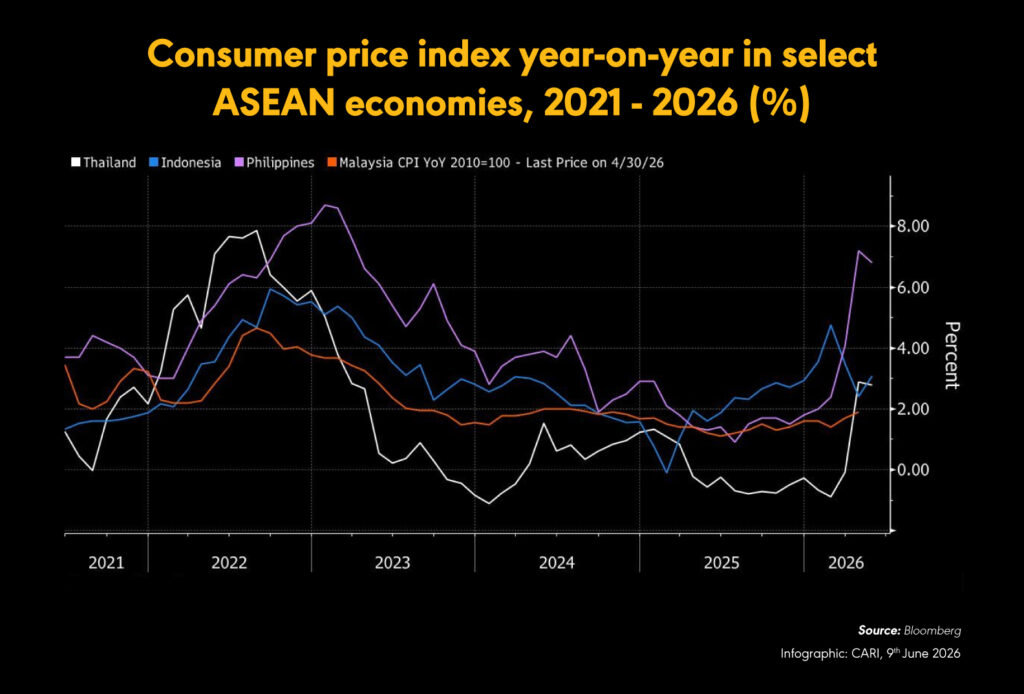
Inflation eases in the Philippines and Thailand in May due to lower global oil prices
(05 June 2026) Inflation eased in the Philippines and Thailand in May, providing greater flexibility for their central banks in assessing further interest rate increases. Philippine consumer inflation slowed to 6.8% year-on-year from 7.2% in April, while Thailand’s inflation rate eased to 2.79% from 2.89%. Lower global oil prices reduced energy, transport and food inflation in both countries, while consumer spending also softened as households controlled costs. Despite the moderation, both governments warned that inflationary pressures could rise again due to the unresolved Iran conflict and Southeast Asia’s reliance on Middle Eastern oil imports. Barclays said the latest inflation data reduces the urgency for off-cycle tightening by the Bangko Sentral ng Pilipinas (BSP). However, they expect Philippine inflation to remain above the BSP’s 2%-4% target range through April 2027, supporting the possibility of a further 25-basis-point rate increase at the June meeting. Barclays also expects Thai inflation to exceed the Bank of Thailand’s 1%-3% target range in the second half of the year. The Bank of Thailand may nevertheless keep its policy rate unchanged at 1% and look through the supply-driven inflation shock.
ASEAN
Southeast Asia credit rating stable despite continued currency depreciation pressures
(08 June 2026) Moody’s Ratings expects overall credit strength among Southeast Asian non-financial companies to remain stable over the next 12–18 months, despite continued currency depreciation pressures. The agency said 83% of rated issuers either have no material foreign-exchange exposure or possess sufficient financial buffers to absorb further currency weakness. Currency depreciation across the region intensified during 2025 and 2026 due to the escalating West Asia conflict, higher oil prices, US tariffs and foreign capital outflows. Over the past year, Indonesia’s rupiah, India’s rupee and the Philippine peso have depreciated by 10%–12% against the US dollar, while Malaysia’s ringgit and Thailand’s baht have appreciated, supported by commodity exports and manufacturing-related capital inflows. Moody’s said the credit impact varies according to companies’ revenue and cost currency profiles. Airlines face the greatest pressure because of high US dollar-denominated costs and predominantly local-currency revenues. Companies in mining, commodities and information technology services benefit from US dollar-linked revenues, which provide a natural hedge, support local-currency profit margins and improve export competitiveness. Firms with substantial US dollar debt and mainly domestic revenue bases face higher debt-servicing and repayment costs when local currencies weaken. However, companies reliant on foreign-currency debt may face higher hedging costs if the US dollar remains strong, increasing overall financing expenses despite stable base interest rates.
VIET NAM
VinFast reports first-quarter revenue of VND 23.11 trillion amidst strong Southeast Asian demand
(08 June 2026) Vietnamese electric vehicle (EV) manufacturer VinFast reported first-quarter revenue of VND 23.11 trillion (USD 877.24 million), up nearly 42% from VND 16.31 trillion a year earlier, driven by strong electric vehicle demand in key Southeast Asian markets. The company has increasingly focused on Viet Nam, India and Indonesia as growth markets amid weaker EV demand in countries such as the United States. First-quarter net loss widened about 59% year-on-year to VND 28.11 trillion as VinFast continued investing in new factories and expanding production capacity to meet demand. In May, the company agreed to supply GSM, a taxi operator founded by VinFast founder and chief executive Pham Nhat Vuong, with around one million electric vehicles and four million e-scooters between 2026 and 2030. VinFast also announced plans last month to sell its Viet Nam manufacturing facilities to a buyer group that includes Vuong as part of a restructuring of its domestic operations.
MALAYSIA
Malaysia records MYR 92.8 billion in approved investments in first quarter of 2026
(08 June 2026) Malaysia recorded MYR 92.8 billion in approved investments in the first quarter of 2026, down marginally from MYR 93 billion a year earlier, across 1,249 projects, while expected job creation rose 46.7% to 50,226 positions from 34,240. Foreign investments totalled MYR 56.2 billion, representing 60.5% of approvals, while domestic investments increased 13% year-on-year to MYR 36.6 billion. Japan was the largest foreign investor with MYR 21.5 billion in approved investments, up from MYR 1.6 billion a year earlier, followed by China and the United States at MYR 10.1 billion each, Singapore at MYR 6.7 billion and Thailand at MYR 2.5 billion. Selangor led with MYR 33.5 billion in approved investments, nearly tripling from MYR 11.8 billion in 1Q2025, followed by Johor and Kuala Lumpur with MYR 16.9 billion each. The services sector accounted for MYR 60.8 billion, or 65.5% of total approvals, driven by information and communications investments of MYR 38.9 billion, including MYR 34.6 billion in data centre and cloud computing projects across 33 developments. Manufacturing approvals fell 20.8% year-on-year to MYR 24.1 billion, although Mida said investments increased 1% excluding a MYR 6.6 billion basic metals project approved in 1Q2025. Manufacturing projects are expected to generate 30,468 jobs, representing 60.7% of total projected employment, with 17.9% of new jobs offering monthly salaries above MYR 5,000. The primary sector recorded RM7.9 billion in approved investments, up from RM1.5 billion a year earlier, driven entirely by offshore oil and gas development and exploration projects, mainly in Sarawak. As of 05 May, Mida was facilitating 182 potential projects worth MYR 38.3 billion and was in active discussions on a further MYR 91 billion of potential investments.
MALAYSIA, THAILAND
Malaysia awaiting Thai response on questionnaire regarding shrimp imports in light of recent import ban
(08 June 2026) Malaysia is awaiting Thailand’s response to a questionnaire on shrimp imports before determining whether the country complies with Malaysia’s biosecurity requirements. The Agriculture and Food Security Ministry submitted the questionnaire through Malaysia’s agricultural representative office in Bangkok and will assess Thailand’s compliance once a complete response is received. No deadline has been set for Thailand’s reply. Malaysia has also strengthened biosecurity controls on Thai sea bass imports by requiring a Certificate of Analysis (CoA), mirroring restrictions and full inspections imposed by Thailand on Malaysian sea bass exports. On 16 May, Malaysia tightened controls on Thai fishery products by introducing CoA requirements for sea bass and imposing a temporary ban on five shrimp species effective from last Monday. The affected species are Penaeus esculentes, Fenneropenaeus merguiensis, Penaeus vannamei, Penaeus monodon and Penaeus stylirostris. Thailand has indicated it may raise Malaysia’s temporary suspension of the five shrimp species at the World Trade Organisation and ASEAN forums if bilateral negotiations do not resolve the dispute.
INDONESIA
Indonesia’s financial markets weaken further on 08 June despite new measures to support rupiah
(08 June 2026) Indonesia’s financial markets weakened further on Monday despite new measures announced by Bank Indonesia (BI) and the government to support the rupiah and attract capital inflows. The 10-year government bond yield rose 36 basis points to its highest level in more than a year at 7.24%, while the rupiah fell 0.9% to a record low of 18,180 per US dollar and the benchmark stock index extended losses, leaving it down 37% year-to-date. The rupiah has depreciated more than 8% this year, while foreign investors have withdrawn a net USD 3.6 billion from equities and USD 422 million from bonds amid concerns over President Prabowo Subianto’s fiscal spending plans, interventionist economic policies and rising risk perceptions. Over the weekend, BI Governor Perry Warjiyo and Finance Minister Purbaya Yudhi Sadewa pledged to maintain market liquidity, raise returns on government-related deposits and support higher bond yields to attract inflows. Analysts said the bond sell-off reflected continued foreign outflows and insufficient confidence in the government’s measures. BI raised interest rates by 50 basis points last month and has continued currency intervention, contributing to a decline in foreign-exchange reserves for a fifth consecutive month to USD 144.9 billion in May. Strategists suggested the rupiah may require a rate increase exceeding 50 basis points, with one analyst forecasting a 75-basis-point hike. Investor concerns have also been fuelled by expanded parliamentary oversight of BI, a corruption investigation, new commodity export rules and uncertainty over potential changes to economic policymakers. Finance Minister Purbaya recently told S&P Global Ratings that Indonesia would maintain its fiscal deficit below the legal ceiling of 3% of GDP.
SINGAPORE
Government warn of increased pressure on growth and inflation in second half of 2026
(08 June 2026) Singapore Prime Minister Lawrence Wong said the economy has yet to experience the full effects of the Middle East conflict, warning of increased pressure on growth and inflation in the second half of the year. He noted that electricity, food and fertilizer prices have not yet fully reflected higher global oil prices, while the global economy has so far been supported by alternative oil supplies and inventory drawdowns following the closure of the Strait of Hormuz. Wong said a prolonged disruption lasting several months could weaken global demand and adversely affect Singapore’s trade-dependent economy. Economists surveyed by Bloomberg expect Singapore’s economy to grow 3.3% in 2026, down from an earlier forecast of 3.5% and from 5% growth recorded in 2025. Wong also warned of a developing pattern of “mutually assured disruption” between the United States and China, where retaliatory restrictions could leave both economies worse off. He welcomed the recent summit between US President Donald Trump and Chinese President Xi Jinping, saying continued communication reduces the risk of miscalculation and helps preserve strategic stability. Wong reiterated concerns that rising protectionism, geopolitical tensions and renewed US tariff threats are contributing to economic fragmentation. He said Singapore will continue diversifying its economic partnerships and expanding trade links with India, the Gulf region and Europe. Wong also defended continued engagement with a broad range of countries, noting Singapore’s recent diplomatic outreach to North Korea despite policy differences.
RCEP Monitor
SOUTH KOREA
Concerns over rapid growth of leveraged retail investing in South Korea
(08 June 2026) Concerns are increasing over the rapid growth of leveraged retail investing in South Korea following a sharp correction in the KOSPI, which has nearly doubled this year and surpassed 8,000 points, driven largely by the artificial intelligence boom. Samsung Electronics and SK Hynix, whose shares have risen 174.4% and 217.9% respectively this year, both exceeded USD 1 trillion in market capitalisation in May and together account for 47% of the KOSPI index. On Friday, the KOSPI fell as much as 6.9% before closing down 5.5%, with Samsung and SK Hynix declining 6.4% and 9.9% respectively. Margin balances held by retail investors reached KRW 27.8 trillion (USD 18.3 billion) on 01 June, up 61.6% since the start of the year, while exchange-traded fund market capitalisation rose more than 70% to KRW 514.4 trillion. Morgan Stanley warned that high retail leverage and increased use of leveraged ETFs could amplify future market volatility during corrections. The Governor of the Bank of Korea cautioned that leveraged positions could trigger automatic selling and intensify market declines. Analysts said the rise in leverage reflects structural retirement funding pressures, with the national pension replacing only 27%-28% of pre-retirement income and only 5.7% of households holding sufficient financial assets to generate a retirement income replacement rate above 20%. Fitch Ratings described the current AI-driven semiconductor cycle as a structural growth trend rather than a temporary upswing. Analysts also attributed part of the market rally to corporate governance reforms under President Lee Jae Myung, including amendments to commercial legislation aimed at strengthening shareholder protections and improving capital efficiency. However, researchers and market participants said further governance reforms, disclosure improvements and regulatory oversight will be required to sustain the market’s re-rating.
JAPAN
Economy slows down to 1.8% in January-March quarter due to weaker capex
(08 June 2026) Japan’s economy expanded at an annualised rate of 1.8% in the January-March quarter, revised down from the preliminary estimate of 2.1%, reflecting weaker-than-expected capital expenditure. On a quarter-on-quarter basis, GDP grew 0.5%, unchanged from the initial estimate and above economists’ median forecast of 0.3%. Private consumption increased 0.3%, matching preliminary data. Business capital expenditure contracted 0.7%, a significant downgrade from the initial estimate of a 0.3% increase. External demand contributed 0.3 percentage point to GDP growth, while domestic demand added 0.2 percentage point, both unchanged from preliminary estimates. The revised data highlights economic vulnerabilities as Japan faces rising energy costs linked to the Middle East conflict and the effective closure of the Strait of Hormuz. Prime Minister Sanae Takaichi’s government has finalised a USD 19 billion supplementary budget for the current fiscal year to mitigate the impact of higher energy prices on households. Rising fuel costs are increasing inflationary pressures, reducing household purchasing power and squeezing corporate margins. The Bank of Japan is scheduled to hold a policy meeting next week and is reportedly expected to raise interest rates unless a significant escalation of the conflict causes market disruption.
CHINA
LNG imports increase sharply to highest level since February in anticipation of summer heat
(08 June 2026) China’s liquefied natural gas (LNG) imports have increased sharply, with the 30-day moving average rising to 178,000 tonnes per day, the highest level since early February and close to the five-year seasonal average. The increase has been driven by higher electricity demand during the summer period and rising procurement activity from state-owned and private buyers. State-owned Cnooc Ltd and other importers are taking around seven to 10 cargoes per month, partly to replace reduced Qatari supply, while private firms including Guangdong Jovo Energy Group Co Ltd have also increased spot purchases. Traders indicated that buying activity accelerated from late April, with Cnooc securing multiple cargoes for delivery between June and August and Zhejiang Energy International Ltd purchasing a July cargo. Disruptions linked to the Middle East conflict have reduced LNG shipments from Qatar, although this has been partially offset by increased exports from Canada, Malaysia and Russia based on ship-tracking data. China’s higher LNG demand could intensify competition with Europe for cargoes ahead of winter storage replenishment, as Europe’s 30-day average LNG imports have fallen 19% year-on-year and declined since mid-March. The current demand rebound contrasts with weaker Chinese LNG consumption in the previous year, when higher reliance on pipeline gas, inventories, coal and renewables reduced import needs.
|
15 participating countries |
20 chapters |
2.2 billion |
US$26.2 trillion |
28% |
| ASEAN member states, Australia, China, Japan, South Korea, New Zealand | trade in goods and services, investment, intellectual property, e-commerce, competition, SMEs, economic and technical cooperation, and government procurement | combined population, 30% world’s population | combined GDP, 30% global GDP | global trade (based on 2019 figures) |