


CARI Captures Issue 749: Peso expected to weaken further against US Dollar despite anticipated rate hikes
Captures has widened its scope to include news related to all the members of the Regional Comprehensive Economic Partnership (RCEP) agreement which was signed towards the end of 2020. Besides the ASEAN Member States, this includes Australia, New Zealand, China, Japan, and South Korea. The other weekly newsletters under CARI, China-ASEAN Monitor and Mekong Monitor will also be consolidated into the Captures newsletter. We hope this new version of Captures will serve you better and look forward to providing a curation of stories relevant to ASEAN and its trading partners.
THE PHILIPPINES
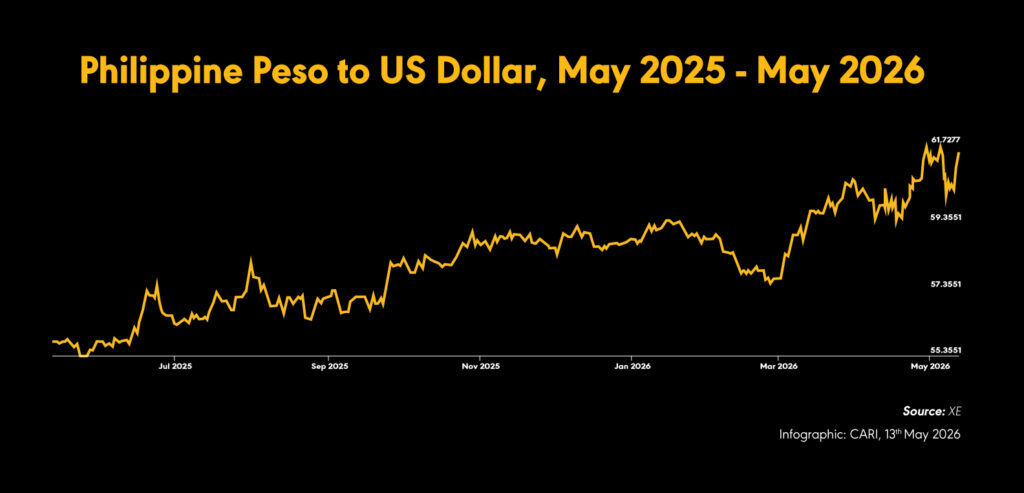
Peso expected to weaken further against US Dollar despite anticipated rate hikes
(11 May 2026) Analysts said the Philippine peso is expected to weaken further against the US dollar despite anticipated Bangko Sentral ng Pilipinas interest-rate hikes of up to 100 basis points in 2026. Strategists from Sumitomo Mitsui Banking Corp, BNY and MUFG Bank said rising oil import costs linked to the US-Iran war are weighing on the Philippines’ growth outlook and trade balance. The peso has fallen about 3% this year to 60.61 per dollar after reaching a record low in late April, with forecasts pointing to further depreciation toward 62 to 63 against the dollar. Australia & New Zealand Banking Group said the peso is likely to retain a weakening bias due to an uncertain growth outlook, a wide current account deficit and elevated inflation risks, with ANZ forecasting a year-end level of 63.0. BNY said higher oil prices are offsetting the usual currency support from rate hikes by increasing dollar demand for imports and adding downside pressure on economic growth. Market reaction indicated limited investor confidence in the expected rate hikes, with the peso underperforming Asian peers on 24 April despite BSP guidance signalling modest tightening measures. First-quarter GDP growth was 2.8% year-on-year, below estimates, while household consumption recorded its slowest pace in nearly 16 years outside the pandemic period. Global funds have withdrawn more than USD 400 million from Philippine equities since the conflict began, while the stock market benchmark has declined 1.5% this year, making it the second-worst performer in Southeast Asia after Indonesia. Inflation pressures have also intensified, with April consumer prices rising at the fastest pace in three years.
MALAYSIA
New EV policy designed to develop broader domestic automotive ecosystem
(11 May 2026) Malaysia’s Deputy Investment, Trade and Industry Minister said Malaysia’s EV policy is aimed at developing the broader domestic automotive ecosystem rather than protecting Malaysian automobile companies Proton and Perodua. He was responding to concerns over new Ministry of Investment, Trade and Industry rules requiring imported EVs to have a minimum price of MYR 200,000 and motor power of at least 180kW from 01 July, 2026. He said foreign EV manufacturers are being encouraged to establish operations in Malaysia and collaborate with local suppliers to strengthen capabilities, move vendors up the value chain, and support future autonomous driving technologies. The minister said the policy covers the wider industry ecosystem, including European, Japanese, and Chinese carmakers operating in Malaysia. He said EVs priced between MYR 100,000 and RM200,000 can still be offered through local manufacturing arrangements. The minister said the government is focused on building a “complete ecosystem” covering manufacturing, supply chains, infrastructure, talent, and innovation. He said Malaysia’s automotive sector contributed an estimated MYR 80 billion to MYR 95 billion to GDP in 2025 and supported more than 750,000 jobs. He said Perodua works with about 190 vendors while Proton has 116 vendors, with combined procurement spending of nearly MYR 15 billion on local parts suppliers.
MALAYSIA
Industrial production index expands despite decline in mining output
(11 May 2026) Malaysia’s industrial production index expanded 3.1%, below the 3.5% median consensus forecast due to a sharper decline in mining output. Kenanga Research upgraded its 2026 manufacturing IPI growth forecast to 4.3% from 3.5% after stronger-than-expected production performance in the first quarter of 2026, with momentum expected to continue into the second quarter. The firm said manufacturers are accelerating stockpiling activity to mitigate raw material shortage risks linked to Middle East-related supply disruptions. Kenanga Research said stronger first-half 2026 output could partially offset slower growth in the second half if geopolitical tensions and commodity price volatility intensify. The latest manufacturing PMI rose to 51.6 in April, the highest level in four years, indicating a stronger start to the second quarter. Hong Leong Investment Bank said global manufacturing activity improved in April, supported by stronger output and new orders, although some demand reflected frontloading ahead of potential supply shortages and higher costs. HLIB said supply chain risks may continue to affect Malaysia’s commodity-related production, while the electrical and electronics sector remains supported by the global technology upcycle. Both Kenanga Research and HLIB maintained their 2026 GDP growth forecast at 4.5%. Kenanga Research raised its first-quarter GDP growth estimate to 5.1% from 4.7%, citing stronger manufacturing activity. The firm projected second-quarter growth of 5.3%, supported by inventory accumulation and stronger services activity linked to Visit Malaysia 2026, which is expected to offset mining sector weakness. Kenanga Research said growth momentum may moderate in the second half of 2026 if geopolitical tensions persist, the 2025 base effect intensifies, and inventory restocking eases.
VIET NAM
Seafood exports projected to rise to USD 12.3 billion in 2026
(11 May 2026) Viet Nam’s seafood exports are projected to rise by about USD 1 billion in 2026 from USD 11.3 billion in 2025 to approximately USD 12.3 billion, supported by recovering global demand and adaptation efforts by exporters. The secretary general of the Vietnam Association of Seafood Exporters and Producers said seafood export turnover reached nearly USD 4 billion in the first four months of 2026, up more than 14% year-on-year. April exports were estimated at USD 947.8 million, bringing cumulative exports to about USD 3.6 billion, an 11.9% increase. Shrimp and pangasius remained the main export products, while tuna exports declined about 6% due to international market pressure and stricter import regulations. Exports to mainland China and Hong Kong exceeded USD 1 billion in the first four months, recording strong growth from a year earlier. Japan maintained stable growth, while exports to the United States fell by about 6% to 7% due to trade policies and trade remedy cases. Nam said the decline in the US market was mainly linked to technical barriers rather than weaker consumer demand. VASEP said the US and European Union continue to introduce stricter regulations covering environmental protection, traceability and social responsibility. EU supply chain due diligence requirements now require businesses to assess production chains against sustainability criteria, while the EU’s yellow card warning on Vietnam’s seafood exploitation activities remains in place. In the US, anti-dumping investigations, anti-subsidy cases and other trade defence measures have become increasingly complex, although coordination between authorities and businesses has helped lower tariff rates in several cases.
THAILAND
Finance Minister defends government’s THB 400 billion emergency borrowing decree
(11 May 2026) Thailand’s Finance Minister defended the government’s THB 400 billion emergency borrowing decree, including THB 200 billion allocated for energy transition measures, following a petition by the People’s Party to the Constitutional Court challenging the urgency and necessity of the borrowing. The minister said Thailand was facing a complex economic crisis driven primarily by rising energy costs and heavy dependence on imported oil and natural gas. He said the issue had also been discussed at the ASEAN level because Thailand remains highly reliant on external energy supplies. The minister said rising energy costs were directly contributing to inflation, with the latest monthly inflation rate at 2.9% and potentially rising to 4% to 5% due to higher goods and living costs. Food prices have already increased by nearly 10%, prompting the government to prepare measures for further potential crises. He said discussions had already taken place with the Bank of Thailand through a joint meeting of four economic agencies and that full-year inflation was still expected to remain close to the central bank’s 1% to 3% target range. The minister described the current situation as different from the 1997 financial crisis and the Thai Khem Khaeng period because the present crisis directly affects household living costs and livelihoods. He said the emergency borrowing decree was necessary to enable the government to respond quickly to the risk of the crisis spreading further. Responding to criticism referencing Moody’s positive assessment of Thailand’s economy, the minister said the agency’s comments related to the country’s strong international reserves and financial stability rather than domestic economic hardship.
LAO PDR
Lao PDR seeks expanded market opportunities for local products
(10 May 2026) The 12th One District One Product and Model Family Product Exhibition is being held in Vientiane from 04 May to 10 May to promote locally produced goods, support micro, small and medium-sized enterprises and expand market access for Lao products. The event features 170 business units and products from nine provinces across Lao PDR. The One District One Product initiative, introduced in 2013, encourages each district in Vientiane to develop at least five signature products. As of May 2026, Vientiane has certified 77 business units under the programme and developed 319 products across 65 villages. The exhibition also includes seminars on solar energy, competitions covering recycling, weaving and Lao cooking, as well as youth-focused activities including a children’s fashion show and talent performances. Organisers said the exhibition continues to support domestic product promotion and broader economic growth in Lao PDR.
LAO PDR
Lao PDR calls for stronger cooperation with Viet Nam and Cambodia in multiple sectors
(11 May 2026) Lao Prime Minister Sonexay Siphandone called for stronger cooperation between Lao PDR, Viet Nam and Cambodia in transport connectivity, energy, trade, investment and tourism during a working breakfast meeting on 08 May held on the sidelines of the 48th ASEAN Summit in Cebu, the Philippines. The meeting involved Vietnamese Prime Minister Le Minh Hung and Cambodian Prime Minister Hun Manet and was held at the invitation of Viet Nam, according to the Lao Ministry of Foreign Affairs. The three leaders described the Cambodia-Laos-Vietnam trilateral cooperation mechanism as an important platform for regular consultations and closer cooperation among the neighbouring countries. They reaffirmed commitments to strengthening longstanding friendship, solidarity and mutual assistance between the three nations. The leaders also noted continued expansion of cooperation in politics, defence and security based on mutual trust and understanding. Sonexay thanked his Vietnamese and Cambodian counterparts for congratulating him following his recent re-election. He emphasised the need to strengthen practical cooperation in priority sectors, particularly transport connectivity, energy cooperation, trade, investment and tourism. Sonexay also called for closer coordination and mutual support in regional and international forums to protect common interests. The three leaders agreed that continued high-level exchanges and meetings would further strengthen unity and deepen trilateral cooperation. The meeting reflected the three countries’ commitment to maintaining close coordination on regional and international issues.
RCEP Monitor
AUSTRALIA
Australia to report smaller budget deficit than expected due to higher commodity prices and revenue gains
(11 May 2026) Australia is expected to report a smaller budget deficit than previously forecast in this week’s federal budget, supported by higher commodity prices and inflation-related revenue gains. The government is still expected to remain in deficit over the coming years as the Middle East conflict weakens the economic outlook and contributes to higher energy costs. Australia’s Treasurer said the budget would prioritise spending restraint while also pursuing tax reforms aimed at addressing intergenerational inequality. Analysts expect the 2025/26 deficit to be smaller than the AUD 36.8 billion forecast in the government’s December mid-year projections. The Commonwealth Bank of Australia forecasts a deficit of AUD 29 billion, UBS expects AUD 25 billion and Westpac projects AUD 23.8 billion. Analysts said the budget will be closely scrutinised for the scale of new spending, with concerns that excessive expenditure could increase inflation and interest rates. The Labor government has already announced reforms to the disability welfare programme expected to generate savings of more than AUD 35 billion over four years. Housing-related tax reforms remain under consideration, including potential changes to capital gains tax discounts and negative gearing rules. Local media reports indicated the government may remove the 50% capital gains tax discount on assets held for more than one year and return to taxing inflation-indexed gains under the pre-1999 system, while negative gearing concessions may be restricted. Targeted cost-of-living measures, including a possible extension of fuel excise cuts, are also expected but may require offsetting savings to avoid increasing inflationary pressures. The Reserve Bank of Australia has raised interest rates three times this year to 4.35%, reversing last year’s cuts, while the bank’s governor warned that government cash support measures could complicate inflation management.
AUSTRALIA
Australia’s “petro-diplomacy’ helps ease concerns over domestic energy security
(10 May 2026) Japanese Prime Minister Sanae Takaichi and Australian Prime Minister Anthony Albanese signed a joint statement on energy security during Takaichi’s visit to Canberra, reinforcing commitments to maintain fuel supplies between the two countries. The agreement followed similar energy security declarations Australia secured with South Korea, Singapore, Malaysia and Brunei Darussalam as part of intensified diplomatic efforts to address fuel supply risks linked to the Middle East conflict. Australia remains heavily dependent on imported refined oil products from Asian countries despite being a major exporter of liquefied natural gas and coal. Foreign Minister Penny Wong also travelled to China to seek the resumption of jet fuel exports to Australian companies amid indications Beijing may ease restrictions on oil product exports imposed after the US-Israel conflict with Iran. Wong told Chinese officials that reliable fuel supplies into Australia were essential for maintaining exports of Australian LNG and coal to Asian buyers. The diplomatic efforts helped ease concerns following panic buying in March and April, when the government issued daily updates on petrol stations that had run out of fuel. Qantas’ chief executive said the government’s diplomatic engagement had improved confidence in fuel supply stability and that increased shipments from China would complement imports from the United States and Mexico. Concerns over fuel security intensified after oil shipments through the Strait of Hormuz were severely disrupted and diesel stocks in March fell below the equivalent of 30 days of demand, while a fire in April affected one of Australia’s two remaining refineries. The government said it had secured an additional 450 million litres of diesel and 100 million litres of jet fuel, with seven vessels carrying diesel cargoes from the United States heading to Australia last month. Analysts said Australia had used its position as an LNG and coal supplier to strengthen negotiations with Asian fuel exporters, although concerns remain over tightening global oil supplies and reduced refinery utilisation rates in parts of Asia.
SOUTH KOREA
South Korean equities reach record levels on 11 May on rally in semiconductor stocks
(11 May 2026) South Korean equities reached record levels on 11 May as the Kospi index surged up to 5.05% in early trading to 7,876.60, triggering a trading curb due to rapid gains. Samsung Electronics rose more than 5% and SK Hynix gained over 10%, with both hitting record highs amid continued strength in semiconductor stocks. The rally followed a 13.6% weekly gain last week, the strongest since late 2008, bringing year-to-date gains to 85% after a 76% rise in the previous year. The market performance has been driven by optimism over artificial intelligence demand and strong US technology sector momentum, including a 5.5% rise in the Philadelphia Semiconductor Index and a 15.5% jump in Micron Technology. South Korea’s exports increased 43.7% in the first 10 days of May year-on-year, supported by a 150% surge in chip exports. Retail investors recorded net purchases of KRW 1.2 trillion (USD 815.66 million), while foreign investors were net sellers. Analysts warned of rising profit-taking pressure and potential short-term volatility in semiconductor shares as gains extend. Broader Asian markets including Japan and Taiwan rose less than 1%, while US stock futures declined amid geopolitical uncertainty in the Middle East. Automakers and battery manufacturers also advanced, although 681 of 894 traded stocks declined despite overall index gains. The won weakened 0.48% to 1,469.4 per dollar. Korean three-year government bond yields rose 0.6 basis points to 3.567%, while 10-year yields edged down 0.1 basis points to 3.911%.
|
15 participating countries |
20 chapters |
2.2 billion |
US$26.2 trillion |
28% |
| ASEAN member states, Australia, China, Japan, South Korea, New Zealand | trade in goods and services, investment, intellectual property, e-commerce, competition, SMEs, economic and technical cooperation, and government procurement | combined population, 30% world’s population | combined GDP, 30% global GDP | global trade (based on 2019 figures) |