


CARI Captures Issue 727: Private funding for ASEAN’s digital economy lags global growth rate
Captures has widened its scope to include news related to all the members of the Regional Comprehensive Economic Partnership (RCEP) agreement which was signed towards the end of 2020. Besides the ASEAN Member States, this includes Australia, New Zealand, China, Japan, and South Korea. The other weekly newsletters under CARI, China-ASEAN Monitor and Mekong Monitor will also be consolidated into the Captures newsletter. We hope this new version of Captures will serve you better and look forward to providing a curation of stories relevant to ASEAN and its trading partners.
ASEAN
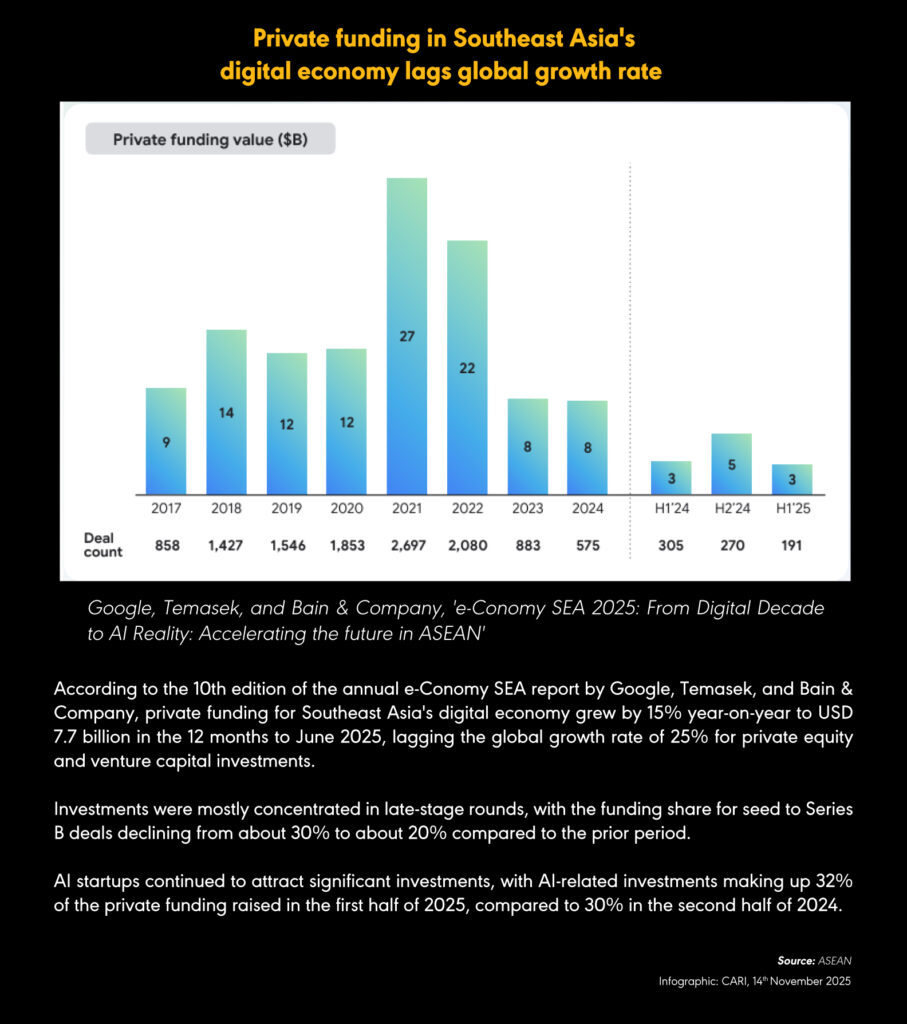
Private funding for ASEAN’s digital economy lags global growth rate
(11 November 2025) Private funding for Southeast Asia’s internet economy increased 15% year-on-year to USD 7.7 billion in the 12 months to June 2025, remaining about 70% below the 2021 peak of USD 27 billion and below the global private equity and venture capital growth rate of 25%, according to a report by Google, Temasek, and Bain. The report noted a shift toward late-stage investments, with seed-to-Series B funding falling from roughly 30% to about 20% over the period. For the first time, the report expanded its market coverage to include Brunei Darussalam, Cambodia, Lao PDR, and Myanmar. AI-related funding accounted for 32% of private capital raised in the first half of 2025 versus 30% in the second half of 2024, with over 680 AI startups securing more than USD 2.3 billion in the year to June, including more than 495 based in Singapore. The report highlighted accelerated data centre expansion, projecting Southeast Asia’s capacity to increase 2.8-fold once planned projects are completed, compared with 2.2-fold growth for the broader Asia-Pacific region. It cited major commitments such as TikTok’s nearly USD 4 billion data hosting plan in Thailand and further planned investments by Google and Amazon of USD 1 billion and USD 5 billion, respectively. Malaysia is expected to lead regional capacity growth with 2,415 MW of planned additions out of the region’s 4,620 MW total, supported by investments from Microsoft, Amazon, Google, Tencent, Huawei, and Alibaba, driven by favourable land and electricity costs and strong projected AI demand.
VIET NAM
Auto sales rise by 24% month-on-month in October 2025
(13 November 2025) Vietnam Automobile Manufacturers Association (VAMA) members sold 37,910 vehicles in October, a 24% month-on-month increase driven by stronger consumer demand, improved supply, and year-end promotional programmes. The sale of passenger cars rose 33% to 27,246 units, while those of commercial vehicles rose 6.6% to 10,162 units, and those of special-purpose vehicles declined by 15% to 502 units. Sales of locally assembled vehicles increased 19% to 17,129 units, while completely built-up imports rose 28% to 20,781 units, reinforcing the popularity of SUVs, sedans, and MPVs. Experts cited aggressive promotions, better supply chains, eased consumer credit, lower interest rates, rising urban demand, and the rollout of new Japanese, Korean, Chinese, and European models as key drivers. For the first ten months, VAMA members recorded 289,331 units sold, up 9.5% year-on-year, with domestic assembly up 2% and imports up 18%, signalling stronger demand for imported vehicles with broader design and technology options. VAMA data, however, exclude major brands such as VinFast and Hyundai. VinFast delivered a record 20,380 electric vehicles in October and 124,264 units in the first ten months of 2025, marking the highest-ever volume for a Vietnamese automaker and reinforcing its position in the domestic EV segment.
THAILAND
Government offering domestic travellers tax deductions of up to THB 30,000
(11 November 2025) Thailand’s government is offering domestic travellers tax deductions of up to THB 30,000 between 29 October and 15 December to stimulate the economy and support second-tier provinces such as Trang, but local businesses report limited impact due to the short programme window, weak economic conditions, and high household debt. Trang operators cite muted demand, with November–December reservations down about 50% year-on-year, despite 1.3 million Thai visitors in the first nine months of 2025 generating THB 6.7 billion in revenue. Hotel and tour operators note slow business onboarding into the deduction scheme and limited appeal among lower-income travellers who fall outside taxable brackets. The tax incentive forms part of broader government measures, including a THB 60 billion plan to purchase bad debt benefiting two million borrowers and efforts to attract more Chinese tourists. Bank of Thailand economists estimate that second-tier provinces account for about 13% of national tourism income, but the weak economic environment, recent flooding, and tensions from the Thai-Cambodian military clash are weighing on domestic travel sentiment. In Ubon Ratchathani, officials expect hotel occupancy to remain below 40% in the final two months of 2025. Restaurants are seen as the likely beneficiaries of the rebate, which can also be used for food purchases without travel.
THAILAND
BOI approves first phase of FastPass system to accelerate permit and approval processing times
(10 November 2025) The Thai Board of Investment (BOI) approved the first phase of its FastPass system on 10 November 2025, aiming to accelerate “Quick Big Win” investments by integrating seven key agencies — BOI, Department of Industrial Works, IEAT, ONEP, Immigration Bureau, Department of Employment and the EEC Office — to cut permit and approval processing times by 20%–50%. A new Investment Acceleration Subcommittee will oversee implementation and expand FastPass to cover all major business licensing procedures. The BOI meeting also reviewed progress on resolving three structural bottlenecks: electricity supply, where the Energy Regulatory Commission is fast-tracking a network usage guarantee mechanism and plans to finalise UGT2 and Direct PPA criteria and fees by end-2025; land provision, where the Department of Public Works, EEC and IEAT are revising town planning, expediting industrial land EIAs and addressing public thoroughfare issues; and visas and work permits, where e-Visa processing for BOI-approved personnel will be shortened to 1–5 working days, OSS Centre capacity will increase from 200 to 500 queues per day, and technical integration issues in the e-Work Permit system are being resolved.
MALAYSIA
GDP grows 5.2% year-on-year in third quarter of 2025, fastest pace in four quarters
(14 November 2025) Malaysia’s GDP grew 5.2% year-on-year in the third quarter, up from 4.4% in the previous quarter and the fastest pace in four quarters, supported by sustained domestic demand and higher net exports, according to Bank Negara Malaysia’s quarterly report. Services expanded 5.0%, driven by wholesale and retail trade, transportation, food and beverages, and accommodation, while manufacturing grew 4.1% on stronger output in electrical, electronic, and optical products, food processing, and non-metallic mineral and metal subsectors. Mining and quarrying rebounded 9.7% after a 5.2% contraction in the second quarter due to higher natural gas and crude oil production, and construction recorded 11.8% growth, led by civil engineering, specialised construction, and non-residential building activity. The central bank maintained its policy rate this month after cutting it from 3% to 2.75% in July to mitigate external risks and trade uncertainties. Government forecasts place GDP growth at 4%–4.8% in 2025 and 4%–4.5% in 2026, compared with 5.1% in 2024, while the World Bank projects 4.1% growth in both 2025 and 2026 amid expectations of slower medium-term momentum.
INDONESIA
Indonesia plans to commercialise palm oil-derived aviation fuel within two to three years
(14 November 2025) Indonesia is testing palm oil–derived sustainable aviation fuels (SAF) with plans to commercialise them within two to three years, part of a broader effort to reduce energy imports, expand biodiesel use, and increase value-added activities in the palm oil sector. Pertamina is conducting SAF trials with Pelita Air, Garuda Indonesia, and Citilink, claiming potential emissions reductions of up to 84%, with its Cilacap refinery able to produce about 238,000 kilolitres annually and another refinery in South Sumatra able to shift capacity if needed. Current tests involve used cooking oil and palm oil mill effluent after earlier palm kernel oil–based attempts proved too costly. Garuda has trialled palm oil–based jet fuel on Jakarta–Amsterdam flights with stable results, while Airbus Indonesia noted SAF’s compatibility with existing aircraft and airport infrastructure. The government is seeking investment from Danantara, the sovereign wealth fund, to scale SAF production. In parallel, Indonesia plans to raise its biodiesel mandate from 40% to 50% next year, with B50 road tests scheduled for December across six sectors, though officials acknowledge challenges from stagnant palm oil output. To address supply constraints, the Ministry of Agriculture aims to open 600,000 hectares of new oil palm plantations starting next year.
MALAYSIA
Malaysia, Singapore, and Indonesia mull trilateral cooperation under JS-SEZ
(13 November 2025) Malaysia, Singapore, and Indonesia have begun preliminary discussions on potential trilateral cooperation under the Johor-Singapore Special Economic Zone (JS-SEZ), with Malaysia’s Investment, Trade, and Industry Minister stating that senior officials from all three countries will conduct a detailed study following talks held with Singapore’s Deputy Prime Minister and Indonesia’s Coordinating Minister for Economic Affairs at the ASEAN Summit. The exploration marks the first comprehensive assessment of a concept previously raised but not formally evaluated. Malaysia’s Investment, Trade, and Industry Minister said the JS-SEZ is progressing well and that a tripartite expansion could offer additional benefits, though formal engagement will depend on the study’s findings. Singapore’s Deputy Prime Minister earlier disclosed that Singapore is considering collaboration involving both the JS-SEZ and Indonesia’s Batam, Bintan, and Karimun (BBK) region, where Singapore is a major investor. The JS-SEZ currently spans around 357,128 hectares across Iskandar Malaysia, Forest City, the Pengerang Integrated Petroleum Complex, and Desaru.
RCEP Monitor
SOUTH KOREA
South Korea to raise passenger electric vehicle subsidies by 20% in 2026
(14 November 2025) South Korea will raise passenger electric vehicle subsidies by 20% to KRW 936 billion in 2026, up from KRW 780 billion this year, as part of a support package designed to mitigate risks from U.S. tariffs and bolster domestic EV demand. The package includes policy finance exceeding the KRW 15 trillion provided to auto parts suppliers in 2025 and expanded guarantee programmes offering long-term, low-interest loans to parts makers operating overseas, including in the United States and Mexico. The auto sector exported USD 70.8 billion in 2024, representing over 10% of South Korea’s total exports, with Hyundai Motor and Kia facing a 25% U.S. tariff that was reduced to 15% under a recent bilateral agreement. However, the lower tariff has not yet taken effect because both countries have yet to issue the joint fact sheet required to formalise the agreement, despite its announcement more than two weeks ago by U.S. President Donald Trump and South Korean President Lee Jae Myung.
AUSTRALIA
Home loans reach record high in third quarter, reinforcing RBA’s pause
(12 November 2025) Australian Bureau of Statistics data show new residential lending reached a record high in the third quarter, with investor loans rising 13.6% over the September quarter to their strongest level since early 2022 and lifting total dwelling finance to a new peak; investor lending now accounts for about 40% of new loans. Owner-occupier lending also increased in both number and value. ABS attributed the trend to lower borrowing costs and tight rental markets. The data indicate that the Reserve Bank of Australia’s three rate cuts this year have eased financial conditions while inflation remains above target, supporting the RBA’s decision to keep the cash rate at 3.6% and signal a prolonged pause. Commonwealth Bank assessed the lending increase as evidence of a sustained cyclical upturn and as marginal support for the RBA’s stance against additional near-term cuts. The lending figures follow consumer sentiment data showing optimism for the first time in almost four years, while labour market data due Thursday are expected to show unemployment declining to 4.4% in October.
AUSTRALIA
Consumer confidence rise 12.8% in November, marking first return to net optimism since February 2022
(11 November 2025) Australia’s consumer confidence rose 12.8% in November to 103.8, according to Westpac, marking the first return to net optimism since February 2022 and ending a 44-month period dominated by pessimism; Westpac cited strengthening domestic demand and housing activity as key drivers. The Reserve Bank maintained the cash rate at 3.6% last week and indicated limited scope for near-term easing despite three cuts earlier this year. Households’ assessment of their financial position improved, with the family finances next-12-months sub-index up 12.3% to 109.1, though households with mortgages recorded a 0.3% decline in expectations. Labour-market concerns increased, with the Westpac–Melbourne Institute Unemployment Expectations Index rising 9.3% to 139.5. NAB’s October business survey showed declining business confidence but stronger conditions, supported by gains in profitability and trading, while employment was stable. Consumer sentiment toward major purchases strengthened sharply, with the time-to-buy-a-major-item index up 14.9% to 111.6, though the family-finances-vs-a-year-ago sub-index remained in pessimistic territory at 85.2. Homebuyer sentiment was little changed, with the time-to-buy-a-dwelling index down 0.1% to 96.4, while house-price expectations increased 0.3% to 172.4, reaching a new cycle high.
|
15 participating countries |
20 chapters |
2.2 billion |
US$26.2 trillion |
28% |
| ASEAN member states, Australia, China, Japan, South Korea, New Zealand | trade in goods and services, investment, intellectual property, e-commerce, competition, SMEs, economic and technical cooperation, and government procurement | combined population, 30% world’s population | combined GDP, 30% global GDP | global trade (based on 2019 figures) |